Israel Update: Day 685
Hostages Held in Gaza: 50 (20 Living); IDF Soldiers Lost: 898
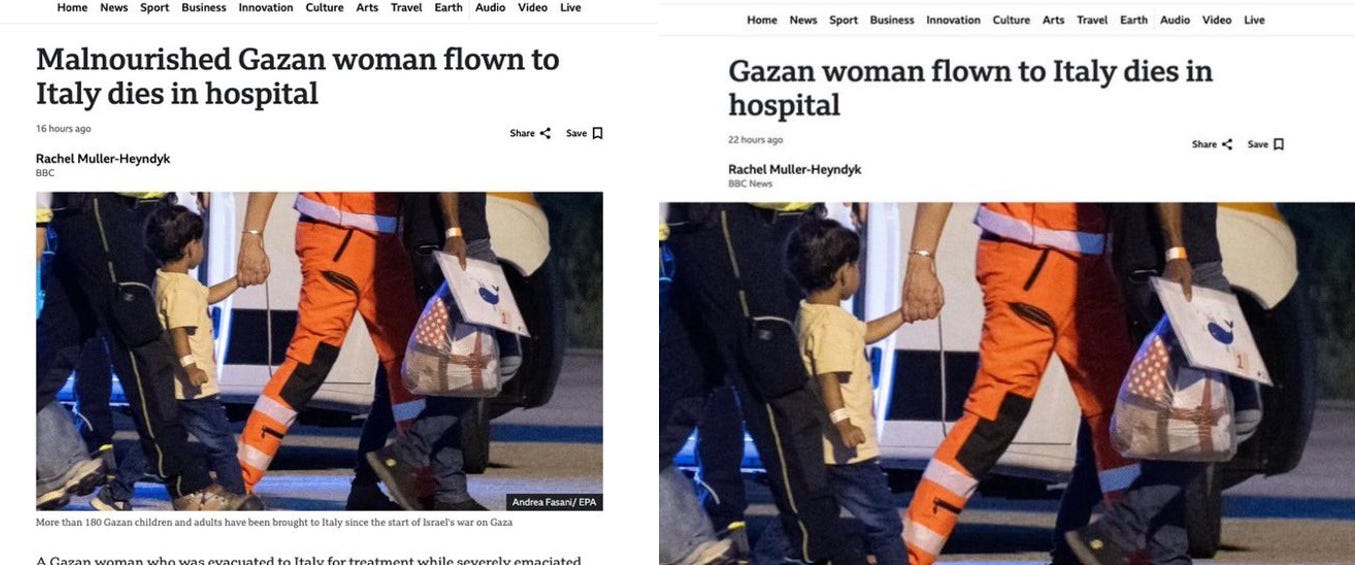
Eyal Yakoby posts on X: The BBC has quietly changed its headline—no apology, no retraction, no correction. Another fake headline, another libel. Who will hold the BBC accountable for this?
The Gaza Strip
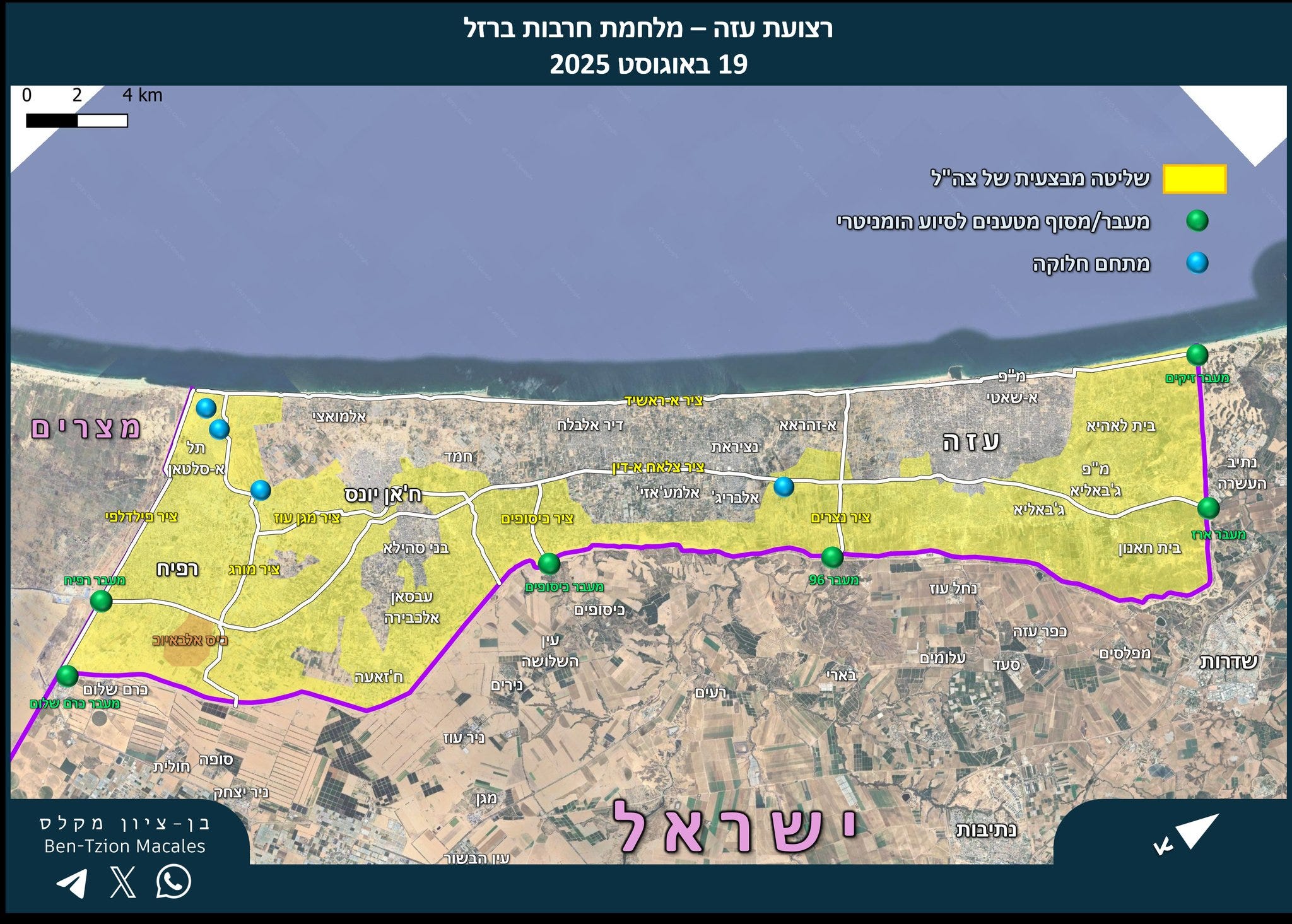
According to Ben Tzion Macales (above): the IDF maintains operational control over approximately 68% of the entire Gaza Strip.
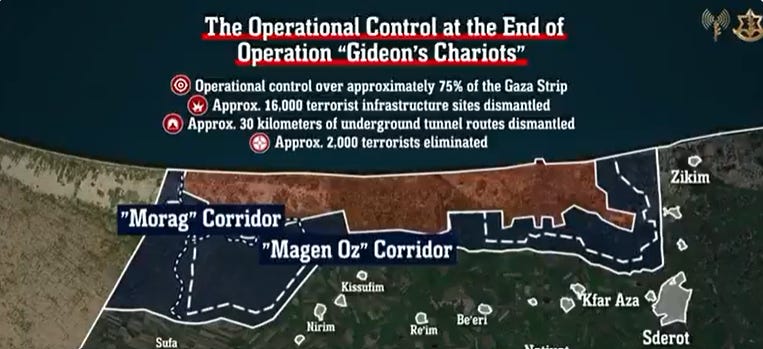
According to the IDF (above):
Operational control of over ~75% of Gaza, striking Hamas’ capabilities and terrorist infrastructure, degrading its chain of command, and allowing the IDF to expand operations.
Elimination of about 2,000 terrorists, including senior Hamas commanders responsible for planning and executing attacks against Israel.
Strikes on approx. 10,000 terror targets from the air, land and sea, dismantling Hamas’ military infrastructure, weapons depots, and underground networks.
Establishment of the “Morag” and “Magen Oz” control corridors, defeating Hamas’ capabilities & brigades.
5 IDF divisions operating simultaneously across Gaza, dismantling terror tunnels, eliminating terrorist cells, and neutralizing Hamas strongholds above and below ground.
Israel/Middle East Related Articles
[MUST READ] They Became Symbols for Gazan Starvation. But All 12 Suffer from Other Health Problems. By Olivia Reingold and Tanya Lukyanova with The Free Press
For the past several weeks, critics have fumed at The New York Times over a misleading photo of an 18-month-old boy in Gaza on its front page.
Muhammad Zakariya Ayyoub al-Matouq wasn’t simply suffering from malnutrition. He had preexisting health issues “affecting his brain and his muscle development.”
When the so-called paper of record updated its story with an editors note four days later, it also quietly deleted the mother’s claim that her son was “born a healthy child.” There was still no mention of the boy’s brother, who appears healthy in the background of another photo that appeared online.
An investigation by The Free Press reveals that at least a dozen other viral images of starvation in Gaza also lacked important context.
The subjects of those photos have significant health problems.
The World Health Organization reported 63 deaths from malnutrition last month alone, including 25 children.
But those photos have helped convince a growing number of Americans that Israel has induced famine and is committing war crimes in Gaza.
Hunger in Gaza is largely declining since Israel resumed aid deliveries in late May after its nearly 80-day blockade.
Food prices are “15 times higher than peacetime,” but are nowhere near their high point earlier this summer.
Images like these have turned the tide against the only Jewish nation in the world—and are pressuring policymakers to isolate Israel.
The children in all of the images reviewed by The Free Press were either sick or facing death at the time their images circulated online.
In every instance, they were already facing grave situations because of their health, irrespective of any third-party action.
These omissions—whether deliberate or negligent—have appeared in some of America’s most prestigious newsrooms, including The New York Times, CNN, and NPR.
Uncovering this missing context didn’t require in-depth, on-the-ground reporting—or months of investigative work. It took minutes, and required nothing more than a computer with a stable internet connection.
“The resulting journalistic products resemble propaganda more than neutral reporting.”
One leading legal expert says these images aren’t just whipping public opinion into a frenzy—they could also play a role in the International Criminal Court (ICC) case against top Israeli leaders, including Prime Minister Benjamin Netanyahu.
Claims of starvation are a “central allegation” in the court’s pursuit of crimes against humanity and war crimes charges.
Since early in the war, international agencies have leaned heavily on famine claims. The Integrated Food Security Phase Classification (IPC), the international body responsible for declaring famine, initially projected in March 2024 that Gaza was on the brink of famine. But three months later, in June, it walked that back, saying that the evidence didn’t support such a declaration after food deliveries increased.
The IPC quietly changed its methodology in Gaza, essentially redefining the criteria for determining a famine.
The images have stirred worldwide anger against Israel.
The inference is that Israel is behind this, and if they just agree to a ceasefire, all of this will stop now—and that is the farthest thing from the truth.
If the war stops now, Hamas will continue to control every grain of rice, every sack of sugar, and use it to enrich themselves at the cost of civilians.
The images have stirred worldwide anger against Israel.
Tzvika Mor, a 47-year-old Israeli, wonders why no one is shouting his son’s name in the streets.
“I don’t know if he has access to food or even water.” A video of David shows him in a dim tunnel digging his own grave. Mor said it has been at least a year since a humanitarian group beyond Israel has contacted him or his family.
“I feel like the world has forgotten about my son.”
Link: They Became Symbols for Gazan Starvation. But All 12 Suffer from Other Health Problems.
Time to Shut Down the Failed U.N. Lebanon Mission by Eugene Kontorovich in The Wall Street Journal
President Trump will soon have a chance to assert U.S. leadership, save taxpayer money and promote peace in the Middle East.
On Aug. 31, the United Nations Security Council is scheduled to vote on whether to renew the mandate of the United Nations Interim Force in Lebanon.
In 2025 Unifil was given the task of disarming Hezbollah and instead enabled the Shiite militia.
The annual vote is typically a rubber stamp, because inertia rules the U.N.
The mission was created in 1978 to monitor an Israeli withdrawal in a long-forgotten skirmish with the Palestine Liberation Organization.
The PLO is no longer in Lebanon, but Unifil still is.
It didn’t keep the peace in 2006, when Hezbollah started a war by taking an Israeli hostage.
It didn’t keep the peace in October 2023 when Hezbollah joined in Hamas’s attack on Israel.
The ensuing war proved Unifil’s corruption. Hezbollah operatives captured by Israel testified that the group paid Unifil personnel to exploit their outposts and security cameras near the border. Hezbollah tunnel shafts were built within 100 yards of Unifil watchtowers, and rocket firing positions put next to Unifil bases. A tunnel running into Israel—designed to facilitate an Oct. 7-style attack—was found dozens of yards from a Unifil “observation” post.
The U.S. is on the hook for 27% of Unifil’s budget, or around $150 million a year
Some in the administration argue the Lebanese army isn’t ready to take over for Unifil. But Unifil doesn’t keep the peace, so there’s nothing to get ready for.
If the U.S. doesn’t veto Unifil, it would undermine the credibility of Washington’s broader demands—both for genuine disarmament of terror groups in Lebanon and Gaza and for broader U.N. reform.
[HIGHLY RECOMMEND] When the Dust of Gaza Will Settle by Jean-David Benichou
In the summer of 2005, Israel withdrew its soldiers and dismantled its settlements from the Gaza Strip…the sudden vacuum left behind by Israel’s departure would set the stage for one of the most consequential political shifts in the Middle East.
From Disengagement to Domination: When Israel’s last soldiers pulled back beyond the Erez crossing, Gaza was left with the promise of self-rule, but also with the curse of factional rivalry…By June 2007, Hamas had seized complete control of the Strip. The experiment in Palestinian democracy was over; the era of Hamas’s monopoly on power had begun.
The Making of a Fortress: It eliminated opposition, imposed strict Islamist norms, and invested in a vast military infrastructure. Tunnels snaked beneath the border with Egypt to smuggle weapons, cash, and goods…Underground bunkers…rocket factories…Militants trained openly, while dissidents whispered in fear
At the same time, Qatar played the role of banker. With Israeli approval, Qatari suitcases of cash crossed through checkpoints to pay Hamas civil servants and keep the Gaza economy on life support…the funds entrenched Hamas’s rule, while the population remained hostage to its rulers’ militant agenda.
Wars Without End: Between 2006 and 2023, Gaza became synonymous with cycles of war. Each confrontation followed a grim pattern: Hamas or Islamic Jihad would launch rockets into southern Israel; Israel would retaliate with overwhelming air power; international mediators would scramble to arrange a ceasefire…Yet Hamas not only survived each round of fighting; it often claimed victory simply by enduring.
October 7: The Breaking Point: On October 7, 2023, the fragile equilibrium shattered…Israel’s response was not a mere reprisal. For the first time since Hamas’s rise, the objective was not deterrence but annihilation.
The Iranian Hand: Evidence quickly emerged that Iran’s role in the October 7 assault was more than ideological. Funding had flowed through complex networks of charities and front companies…Tehran’s objective was clear: to stretch Israel across multiple fronts, from Gaza to Lebanon to Syria and Yemen, while presenting itself as the vanguard of resistance against the West.
Qatar’s Calculated Patronage: If Iran supplied weapons and strategy, Qatar supplied cash and political cover. For years, Qatari payments were funneled into Gaza with tacit Israeli consent, justified as a way to prevent humanitarian disaster…through Al Jazeera, Qatar amplified Muslim Brotherhood propaganda worldwide, rallying leftist movements across the globe in support of Hamas.
The Systematic Unraveling of Hamas: The stripping away of Hamas’s control over humanitarian lifelines marks a profound shift: for the first time in 17 years, Gazans may glimpse survival without the mediation of their rulers.
A Future Beyond Hamas: …the elimination of Hamas could open an unthinkable possibility: reconstruction under the aegis of moderate Arab states. Egypt, the UAE, Saudi Arabia, and Jordan have all signaled willingness to help rebuild Gaza if Hamas is no longer in power. The model often looked at is that of the United Arab Emirates—that could translate in an “Emirates of Gaza” rebuilt with investments in ports, technology parks, and education, offering youth something more than the promise of martyrdom…if regional powers seize the moment, Gaza could transform from a launchpad of terror into a laboratory of prosperity. The choice will ultimately be whether Palestinians accept governance rooted in pragmatism rather than ideology.
Toward an Abrahamic Reconciliation: The end of Hamas would reverberate beyond Gaza. It would signal the decline of radical Islamism as the defining political current of the Middle East, and the ascent of a new regional architecture rooted in shared interests. The Abraham Accords have already shown that Jews and Muslims can cooperate for mutual benefit. A Gaza freed from Hamas could accelerate the birth of an Abrahamic confederation, linking Israel with its Arab neighbors in a confederation of prosperity and stability.
All or nothing: Why Israel should stand firm, avoid phased hostage deals: An Editorial by The Jerusalem Post
By any measure, Israel’s new stance in negotiations with Hamas – that any deal must include the release of all the hostages at once – is the right one. It is right strategically, politically, and most of all, morally.
Up until now, the formula has been phased deals. A few hostages here, a few there, in exchange for temporary truces, prisoner releases, or humanitarian concessions.
The shift to an “all or none” approach is not just a negotiating tactic. It is a much-needed strategic reset on multiple fronts.
First, partial deals have only prolonged the nightmare. Every time Israel agreed to a phased release, Hamas pocketed the gains and came back for more…This piecemeal process served Hamas’s interests perfectly: keep Israel waiting, keep the world watching, keep the families divided, and keep the terrorist organization calling the shots.
Second, the previous approach created a cruel hierarchy. Whose child comes home first? Whose parent is left behind? Whose turn is it to suffer longer? By insisting that all must be freed together, Israel affirms a fundamental moral truth: Every hostage is of equal worth. No life is expendable, no family’s anguish is less urgent.
Third, deterrence depends on clarity. As long as Hamas could calculate that abducting Israelis would generate repeated concessions, kidnapping remained a viable strategy. Requiring the release of all hostages at once is the clearest possible message: This tactic will yield no further dividends.
Fourth, phased deals corrode national cohesion, prolong the whole trauma, and spark bitter protests and internal recriminations.
Fifth, it shuts down Hamas’s psychological warfare. The terror group has never viewed the hostages purely in military terms; they are tools in cognitive warfare, designed to divide Israeli society, erode morale, and fracture cohesion. By releasing some while holding others, Hamas deliberately sowed discord and prolonged trauma.
Sixth, it aligns with Israel’s broader military and political goals. The war aims to dismantle Hamas as a governing and military entity and strip it of the power it held on October 7. Phased hostage deals undercut that aim by prolonging the terror group’s survival as an organization.
The new stance, by contrast, closes down avenues of exploitation, strengthens deterrence, and reasserts the principle that every life matters equally.
Israel will no longer play Hamas’s game of drips and drabs. The demand is simple, moral, and unshakable: all of them, all at once. Nothing less.
Link: Why Israel must demand Hamas release all hostages at once
Antisemitism
What America Can Learn from the Hamas Propaganda War by Mike Watson from The Hudson Institute in The Washington Free Beacon
The war that Hamas started is nearing the end of its second year, and the world is still fixated on the ongoing battle.
The Israeli cabinet’s recent decision to occupy Gaza City has set off a new round of speculation about the fate of Hamas and the people under its thumb.
The quality of the information informing public discussion about the war has often been dismayingly bad.
During previous conflicts, Hamas and its allies developed a relatively successful propaganda strategy focused on large, splashy accusations of Israeli atrocities.
They put this plan into action 10 days after their initial murderous Oct. 7 attack, well before Israeli troops entered Gaza, when they claimed that Israel had bombed Al Ahli Arab Hospital, allegedly killing hundreds of civilians.
This time, Israel and its allies were ready for Hamas’s propaganda.
The Israeli and U.S. governments quickly debunked Hamas’s false claims and showed that militants in Gaza had, probably inadvertently, rocketed their own hospital.
Hamas and its allies reconfigured their tactics.
A Hamas-controlled organization produced highly suspicious tallies of deaths in Gaza, which then-president Joe Biden and his defense secretary Lloyd Austin both cited uncritically.
Israel’s recent actions to bypass Hamas-controlled humanitarian aid channels and send food straight to hungry Gazans forced Hamas to change its tactics yet again.
Over the past few weeks, the media have breathlessly reported lurid stories of starving civilians and massacres near the Israel-supported aid locations.
Many of these stories fall apart upon closer inspection.
In some cases, Israel has released videos proving that the supposed massacres never took place.
But by the time the Israelis showed what actually happened, Hamas has released more equally implausible stories that generate new headlines.
Although it is currently fighting Israel, Hamas is creating a template America’s adversaries can use in future conflicts with the United States.
The next time American troops go into combat against a major enemy, they can expect an incessant stream of reports about alleged massacres and other war crimes.
Many of these atrocities will not be based on anything that actually occurred, but they will nonetheless draw the attention of American media organizations.
Policymakers should thus expect to start any conflict in a hostile media environment.
The U.S. government has a dismal track record at dealing with such propaganda.
These facts point to an important civic duty for the press—and an interesting business opportunity as well.
Debunking lies told by enemies who want to hurt Americans is a good thing to do, and news organizations that do that are performing an important public service.
This is an opportunity to do good and to do well.
Israel Isn’t Losing the Narrative War. You Are! by Guy Goldstein on Substack
“They’re losing the narrative.”
But the problem is not the message. It’s the listener.
The moral compass of Western civilization has been shattered, and the results are on display every day.
This isn’t about Israel’s PR. It’s about the West’s inability to recognize evil even when it broadcasts itself.
Hamas did not try to hide what it was doing. It filmed itself burning children alive, executing parents in front of their kids, parading women through the streets like trophies.
Ghazi Hamad told Lebanese television in late October that “we will repeat October 7 again and again until Israel is annihilated.”
Tens of thousands of people in Western cities poured into the streets not to condemn the atrocity, but to celebrate it.
What happened on October 7 wasn’t just a massacre. It was a mirror, showing the West something it wasn’t ready to see.
Hamas is not simply corrupt or militant. It is a genocidal theocracy that targets civilians on purpose and oppresses its own people to maintain power.
These are not incidental flaws. They are the architecture of the organization.
Evil done in the name of good remains evil.
Western societies are now structurally incapable of processing this distinction.
Western public opinion is not being informed. It is being colonized.
Israel still has moral clarity because it must.
This war will be fought on many fronts: military, political, psychological. But the deepest battlefield is moral.
Right now, it is not Israel that is losing ground. It is the West, and the loss is not tactical. It is civilizational.
The enemy doesn’t need to conquer our capitals if it can conquer our minds.
We are surrendering the very concepts, truth, justice, and good.
We are replacing moral clarity with moral theater, and the price will be paid in blood, not only in Sderot and Tel Aviv, but in Paris, Berlin, and Chicago.
When the day comes that evil wins not by force but by applause, the war will already be over.
Hostage Update (no change)
There are now currently 49 hostages taken on 10/7 currently in captivity in Gaza (there are 50 hostages remaining in total)
Of the 50 hostages still theoretically in Gaza
28 hostages have been confirmed dead and are currently being held in Gaza
Thus, at most, 22 living hostages could still be in Gaza. It has been reported that only 20 are actually alive.
Hamas is now holding the body of 1 IDF soldier who was killed in 2014 (Lt. Hadar Goldin’s body remains held in the Gaza Strip)
20 hostages remain in captivity and have not been declared dead.
2 hostages are Americans: Meet the Two American Hostages Still Held By Hamas:
Itay Chen died on October 7 defending civilians living in an agricultural area near the Gaza borde
Omer Neutra was killed when his team drove two miles to the border, where Hamas militants ambushed his tank with rocket-propelled grenades.
On October 7th, a total of 251 Israelis were taken hostage.
During the ceasefire deal in November of 2023, 112 hostages were released.
38 hostages were released in the first phase of the 2025 cease fire agreement (including 5 Thai nationals)
202 hostages in total have been released or rescued
The bodies of 47 hostages have been recovered, including 3 mistakenly killed by the military as they tried to escape their captors.
8 hostages have been heroically rescued by troops alive
Casualties (no change)
1,951 Israelis have been killed including 898 IDF soldiers and police since October 7th
Iran: 29 Israelis have been killed in Israel from missiles attacks from Iran
The South: 457 IDF soldiers during the ground operation in Gaza have been killed. The toll includes three police officers (two of which were killed in a hostage rescue mission) and two Defense Ministry civilian contractors.
The North: 133 Israelis (85 IDF soldiers) have been killed during the war in Northern Israel
The West Bank: 67 Israelis (27 IDF and Israeli security forces)
Additional Information (according to the IDF):
6,196 (+1) IDF soldiers have been injured since the beginning of the war, including at least 924 (no change) who have been severely injured.
2,874 (no change) IDF soldiers have been injured during ground combat in Gaza, including at least 551 (no change) who have been severely injured.
The Gaza Casualty Count: According to unverified figures from the Hamas-controlled Gaza Health Ministry, 62,004 total deaths have been reported, with a civilian/combatant ratio: 1:1.
[MUST READ] Report: Questionable Counting: Analysing the Death Toll from the Hamas-Run Ministry of Health in Gaza by Andrew Fox with The Henry Jackson Society
Regular sources include JINSA, FDD, IDF, AIPAC, The Paul Singer Foundation, The Institute for National Security Studies, the Alma Research and Education Center, Yediot, Jerusalem Post, IDF Casualty Count, algemeimer, the Washington Institute for Near East Policy, Institute for the Study of War, Tablet Magazine, Mosaic Magazine, Commentary, The Free Press, The Jewish Institute for Strategy and Security, and the Times of Israel