Israel Update
US Service Members KIA: 13; Israelis Killed: 35 (24 civilians/11 IDF)
Situational Update
JINSA reports: On April 13, U.S. Central Command (CENTCOM) implemented a maritime blockade “against vessels of all nations entering or departing Iranian ports and coastal areas.” In announcing the blockade the day prior, President Trump said the U.S. Navy also would intercept ships paying Iranian tolls to transit the Strait of Hormuz.
The Institute for the Study of War (ISW) reports: US Central Command (CENTCOM) reported on April 15 that no vessels had breached the blockade on Iranian ports during the first 48 hours of enforcement.
At least 20 commercial vessels transited the Strait of Hormuz between the morning of April 13 and the morning of April 14
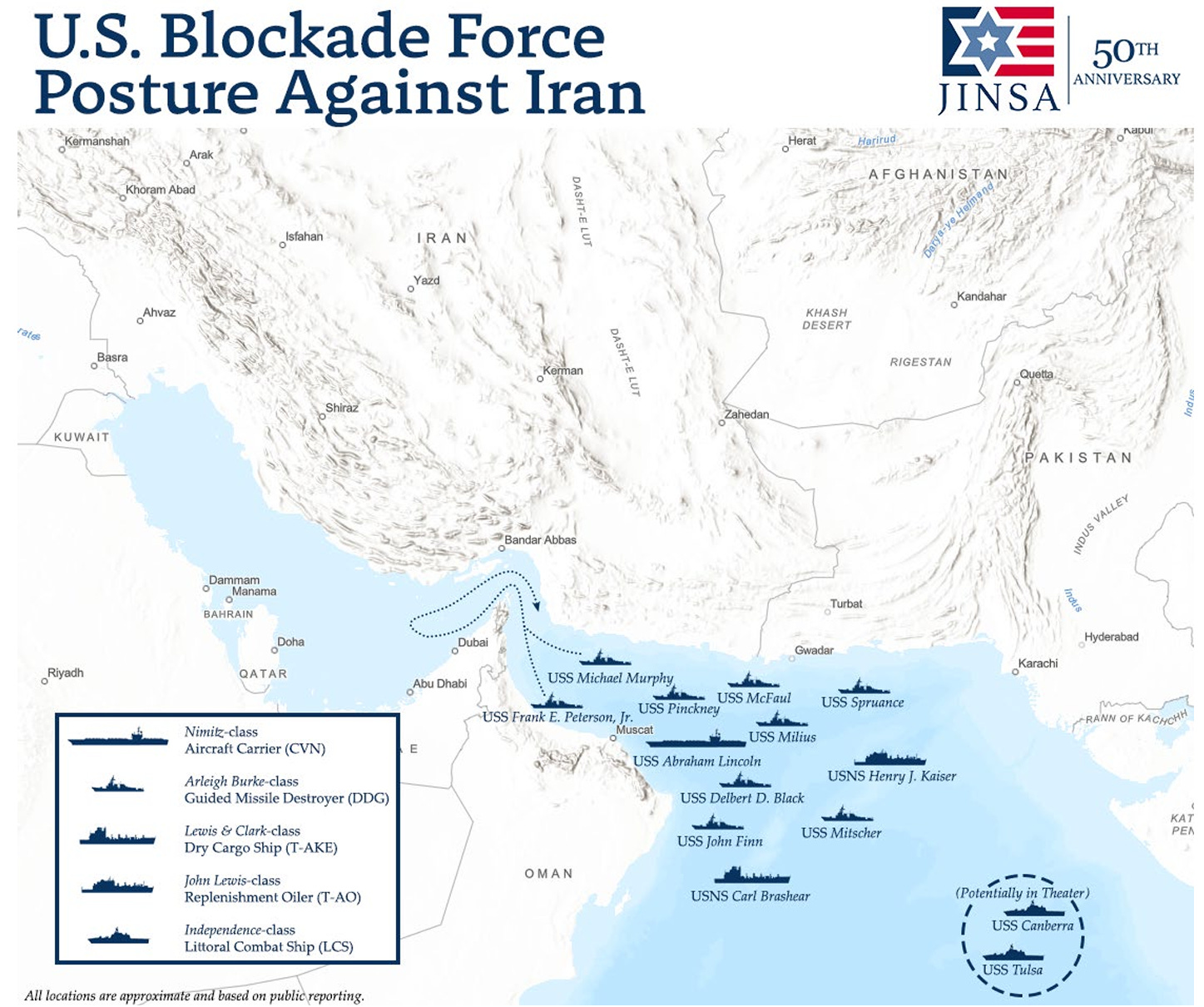
Even if it does not induce negotiating concessions, an effective blockade of Iranian ports and coastal areas could help advance several important U.S. wartime objectives:
Denying revenue-generating exports
Denying military-related imports
Denying Iranian toll revenues and threats to freedom of navigation
The United States has reportedly set two preconditions for another round of negotiations: first, Iran must fully “reopen” the Strait of Hormuz, and second, the Iranian negotiating delegation must have “full authority” to finalize a deal, per ISW
Israel/Middle East Related Articles and Analysis
[MUST READ] Seven Myths About the Iran War: Why so many, on both the left and the right, keep getting Trump wrong by Michael Doran for Tablet
…while Trump has repeatedly defied the Beltway consensus on Iran and its allies over the past year and a half, none of the dire consequences that influential commentators predicted have come to pass.
Trump has inflicted heavy punishment in return for relatively light consequences, but pundits insist that a masterful Iran is dictating events. Tehran’s “successful” war-fighting tactics supposedly forced Trump to accept a cease-fire.
On April 11, New York Times columnist Thomas Friedman said the quiet part out loud…He admitted that while he wanted to see the Iranian regime defeated militarily “because this regime is a terrible regime for its people and the region,” the real problem for him was something else entirely: “I really don’t want to see Bibi Netanyahu or Donald Trump politically strengthened by this war because they are two awful human beings. They are both engaged in antidemocratic projects in their own countries. They’re both alleged crooks. They are terrible, terrible people doing terrible things to America’s standing in the world and Israel’s standing in the world.”
Friedman’s attitude is not idiosyncratic. Across much of the American and Israeli media, seasoned pundits cannot set aside their contempt for Trump and Netanyahu and have joined the chorus portraying the operation as aimless adventurism.
Trump’s Iran campaign is proving so difficult for many observers to parse because it is two conflicts in one.
On the battlefield, it pits American and Israeli forces against the Islamic Revolutionary Guard Corps (IRGC).
At home, in the realm of ideological warfare, it sets two rival American strategic belief systems against each other—but with a twist. In one corner stand traditional conservatives, represented today by Donald Trump and Benjamin Netanyahu. In the other stand the transnational progressives associated with Barack Obama and Joe Biden. But this corner is crowded: Alongside them are influential isolationist figures such as Tucker Carlson and restraint-oriented institutions such as the Cato Institute and Defense Priorities, which routinely repeat the same arguments, often verbatim.
…the progressives and America Firsters share a dislike for American global leadership and the use of military force, and therefore they both excuse the behavior of America’s enemies while blaming it for any conflict.
Progressives and their fellow travelers in the America First movement advance an alternative perspective based on three key principles.
First, military force cannot solve the Iranian nuclear challenge.
Second, diplomacy remains the best tool for moderating the Islamic Republic.
Third, stabilizing the region requires the United States to create distance between itself and its allies, especially Israel.
…the respectful bowing to prudence and restraint in the name of “realism” is mostly a species of fakery. What comes first is not deference to reality, but to ideology. The message is always the same: Pull back militarily from the Middle East, engage Iran diplomatically, and distance America from Israel.
Myth One: This was a “war of choice.”
The administration has, in fact, made a clear and compelling case. It reduces to two interlocking imperatives. The first is Trump’s long-standing red line. As the president has stated repeatedly for years, “Iran cannot have a nuclear weapon. It’s very simple.” The second is the enabling condition that made this red line urgent: overmatch. Iran’s drones and ballistic missiles can overwhelm the air and missile defenses of Israel, the United States, and their Gulf allies.
America therefore had three choices: to do nothing, in which case Iran would soon enter a zone of immunity guaranteed by overmatch; to let Israel attack alone, in which case Iran would attack American forces and cause significant casualties; or to work together with Israel to eliminate an intolerable threat to both countries.
Myth 2: The Joint Comprehensive Plan of Action had moderated Iran and stabilized the Middle East before Trump broke it.
This story fails to comport with reality in three crucial ways. First, the timeline doesn’t work…Trump withdrew from the nuclear deal in May 2018. Tehran did not begin enriching its uranium to 60%, a major threshold that dramatically shortens the path to a nuclear weapon, until April 2021.
As sanctions enforcement weakened and oil revenue from China flowed, the regime did not moderate. Iran accelerated its missile and drone programs, deepened its support for proxies, and hardened the capabilities that now define the battlefield. Sanctions relief generated revenue.
The United States faced the same strategic choice at the end of the JCPOA process as it did at the beginning, but under worse conditions and against a stronger adversary. The policy, that is to say, ensured that the confrontation would come after Iran had advanced closer to immunity.
Myth 3: Biden extracted America from wars in the Middle East.
By avoiding direct confrontation with Tehran and winding down U.S. military involvement, the Biden administration had delivered regional stability and handed its successor an unprecedented calm.
Reality tells a different story, the most violent chapter of which begins on Oct. 7, 2023, when Supreme Leader Ali Khamenei plunged not only Israel but also the United States into one of the most consequential wars of the modern era. That conflict has yet to end, and it is reshaping the entire Middle East.
Meanwhile, Khamenei mobilized the entire Resistance Axis in an asymmetric war against the American alliance system.
Between January 2021 and January 2025, Iranian-backed forces launched hundreds of attacks on American personnel and assets across the Middle East, with the overwhelming majority coming after Oct. 7, 2023.
In any previous era, a sustained campaign of this magnitude against American bases and naval vessels would have been called open war. The Biden administration called it historic peace.
Myth 4: Tehran was ready to compromise.
The regime treats its nuclear program, missile and drone arsenal, and proxy network as a single power complex. In negotiations, it is offering temporary and reversible concessions on enrichment levels and stockpiles in return for sanctions relief, while preserving what matters.
Under the original JCPOA, sanctions relief did not moderate the regime. Iran accelerated its missile and drone programs, deepened its proxy network, and built the capabilities that now allow the regime to hold 20% of the world’s energy supplies hostage. A new deal on the same old terms would simply have transferred further leverage to Tehran while waiting for a new Democratic administration in Washington that would tolerate a breakout.
Myth 5: Israel dragged America into the war.
This myth ignores the central fact that the bill for JCPOA-enabled Iranian empowerment had already landed on Trump’s desk.
First, the Iranian overmatch threat, the danger described in Myth One, endangered both Israel and the United States at the same time.
Second, President Trump is on record as viewing the Islamic Republic as a mortal threat since the early 1980s—long before Netanyahu’s February 2026 presentation at the White House.
Far from being dragged into war, the United States led the operation as the senior partner in a synchronized campaign for which Trump took full responsibility and credit.
Israel stands out as nearly unique among America’s partners: It is one of the very few allies capable of independently prosecuting sustained, high-intensity military campaigns without requiring American ground troops or direct combat involvement. This self-reliance, which allows Israel to act as a powerful force multiplier, contrasts sharply with many other allies that depend on extensive U.S. force presence, logistics, and enablers.
Myth 6: Confronting Iran distracts from China.
The claim rests on a simple assumption: that the Middle East and the competition with China are separate theaters. They are not.
China serves as Iran’s primary economic lifeline through massive purchases of sanctioned oil and, more important, as a supplier of key components that sustain Iran’s military power: sodium perchlorate for solid rocket fuel, carbon fiber, and dual-use electronics.
Weakness in the Middle East does not help America conserve its military power for Asia. It hands Beijing leverage over the energy flows and maritime routes that sustain the Asian alliances on which U.S. strategy in the Pacific depends.
The claim that confronting Iran distracts from China reverses reality. The policies that prioritized restraint, accommodation, and distance from Israel strengthened Iran, expanded China’s leverage, and made the current war unavoidable.
Myth 7: Trump and Netanyahu are warmongering megalomaniacs.
Rather than admit that years of pursuing an accommodation with Iran produced a stronger, more dangerous adversary, progressives attribute the collapse of their approach to the irrational personalities of their opponents. If only cooler, more restrained leaders had remained in charge, the delicate balance with Tehran would have continued uninterrupted.
The American-Israeli campaign achieved its core strategic objectives: halting Iran’s advance toward nuclear weapons capability and significantly degrading its ballistic missile program, which together had posed a growing existential threat to Israel and the region.
This outcome constitutes a clear success because it dramatically lowered the immediate danger without requiring the unattainable “complete victory” standard often demanded by critics who will insist on denying their bêtes noires in Jerusalem and Washington a victory at any cost to their own sense of reality.
The operation also produced important secondary effects: Iran’s proxy network has been visibly weakened.
History will record the opposite: Those who recognized the threat and acted before the window closed dealt with the world as it is and protected the national interest. Those who demanded restraint until restraint was no longer an option built their policies on fantasies that endangered us all.
[HIGHLY RECOMMEND] The War the Arab World Is Watching by Zineb Riboua
Western coverage of Operation Epic Fury has unfolded almost entirely on Iran’s own terms.
The dominant frame across European and American commentary treats the Islamic Republic as the aggrieved party narrating its resistance, and the discussion in mainstream outlets and across social media platforms has largely been organized around what Iran claims, what Iran endures, and what Iran dares to threaten.
This frame leaves an enormous gap in the picture, and the gap is the Arab world — a civilization that has spent forty years watching the Islamic Republic erode its institutional, theological, and cultural foundations.
Three Things the West Cannot See:
The first is the Arab relationship with Iran…What it does not map onto is the lived experience of Arab populations in Lebanon, Iraq, Yemen, Bahrain, Syria, and across the Gulf…Freedom is not the word any serious Arab observer would use for what Iran brought.
The second dimension is the proxy question itself, where Western analysis fails most comprehensively…Iran goes far beyond supporting armed groups. Parallel state structures get built inside Arab countries, financial systems get captured, and political figures get installed who owe their existence and survival entirely to Tehran…what Arab populations have experienced is closer to a colonial occupation conducted through intermediaries, and as of now, they’re not mourning the Islamic Republic…When Westerners treat these proxy networks as instruments of legitimate resistance rather than as mechanisms of subjugation, they endorse an imperial project while believing themselves to be opposing one, and as a matter of fact, make themselves the legitimizing force behind Iran’s war against the Arab world.
The third dimension is the most counterintuitive for a Western audience…Iran represents a greater and more immediate threat than Israel does…Western discourse on the Middle East has been organized for decades around the Israeli-Palestinian conflict as the primary axis of regional injustice…The result is that when Western governments and Western publics take strong positions against Israel’s actions against Iran’s operations, they believe themselves to be standing with the Arab world…In reality, they are advancing a position that the Arab world does not share and has not asked for, while ignoring the threat that Arab governments and Arab populations actually live with.
The rhetorical use of Israel as a perpetual alibi for Iranian aggression has been one of the Islamic Republic’s most durable tools, and Western opinion has served as the unwitting amplifier of that tool across the entire duration of the Islamic Republic’s existence.
The Arab world is watching the proxy architecture Iran spent decades constructing get dismantled, and it is processing the implications for its own political future.
The first thing that has emerged from this is a demonstration of capability that no one predicted…Gulf states that absorbed thousands of rockets and drones while maintaining full civilian life and political composure have revealed a military steadiness that decades of condescension from Western and Arab nationalist commentators had written off as impossible.
The second is a region at a genuine inflection point, one where the destruction of Iran’s proxy architecture opens a real possibility of Arab states governing themselves without external interference for the first time in a generation.
The Arab world has been watching something else entirely, the first serious challenge to an ideology that was never democratically adopted, never welcomed, and imposed through violence and subversion from the moment of its founding.
The United States and Israel, long cast in Arab political culture as the twin engines of regional oppression, are being processed by a significant and growing portion of Arab opinion as something closer to liberators, not in the language of gratitude, which Arab dignity would resist, but in the language of relief.
For Iran, Hormuz Is More a Weakness Than a Weapon by Miad Maleki, Senior Fellow at FDD
Tehran realize that its control of the strait constitutes powerful leverage. In this story line, the strait turned out to be Iran’s real nuclear weapon, its potent deterrent…But this narrative is wrong. More than any other country on earth, Iran cannot survive a sustained closure of the strait.
Within weeks of a blockade, the country could run out of food, as well as space to store unshipped oil, requiring it to decrease or stop production at major oil wells—an act that can damage such infrastructure permanently. By closing the strait, Iran has not established a new, meaningful source of long-term clout. Instead, it has indicated how militaries can decimate the Iranian economy and thus really exert power over the Islamic Republic.
The U.S. naval blockade of the Strait of Hormuz would cost Iran approximately $276M/day in lost exports and disrupt $159M/day in imports, a combined economic damage of ~$435M/day, or $13B/month. Over 90% of Iran’s $109.7B in annual trade transits the Persian Gulf. Oil/gas accounts for 80% of government export earnings and 23.7% of GDP. Kharg Island alone generates ~$53B/year…$78 billion a year in energy revenue
CRUDE OIL: Iran was exporting ~1.5M barrels/day, earning $139M/day at wartime pricing (~$87/barrel), though with minimal proceed repatriation due to banking sanctions. A blockade zeroes this out overnight. Kharg Island, which handles 92% of crude exports, sits deep inside the Gulf with no viable alternative. That's $139M/day, gone.
PETROCHEMICALS: Iran exported $19.7B in petrochemicals in 9 months of 2024/25, ~$54M/day. Virtually all of it ships through Assaluyeh, Imam Khomeini, and Shahid Rajaee, all inside the blockade zone. No overland route can move these volumes. Another $54M/day, gone.
NON-OIL EXPORTS: Iran's non-oil trade hit $51.7B in 2025. After subtracting petrochemicals, ~$88M/day in goods (minerals, metals, etc.) flow through Persian Gulf ports. Roughly 90% would be blocked. That's another ~$79M/day in lost revenue.
PORTS: Over 90% of Iran's seaborne trade transits the Strait of Hormuz. Shahid Rajaee (Bandar Abbas) alone handles 53% of all cargo operations. Imam Khomeini handles 58% of basic goods imports. Bushehr ports moved 57M tons last year. All deep inside the Gulf.
ALTERNATIVES? Iran's options outside the Strait are negligible. Jask, the much-touted bypass, operates at a fraction of its 1M bbl/day design capacity. Only 10 of 20 storage tanks were built. Effective throughput: ~70K bbl/day. Chabahar handles just 8.5M tons/year. The five Caspian ports combined handle 11M tons, versus 220M+ through the Gulf.
IMPORTS: Iran imported $58B in goods in 2025, ~$159M/day. A blockade chokes off industrial inputs, machinery, and consumer goods. Food inflation already hit 105% by February 2026. Rice prices are up 7x. This gets dramatically worse under blockade. Blockade will hopefully allow offloading of the humanitarian cargos.
Extremely important topic is the storage clock: Iran has ~50-55M barrels of total onshore oil storage, roughly 60% full. Spare capacity: ~20M barrels. With 1.5M bbl/day of surplus production that normally exports, storage fills in ~13 DAYS. After that, Iran must shut in wells. Why is this very important: when mature oil wells shut down, bottom water rushes in, a process called water coning. Oil droplets get permanently trapped in rock pores. This oil can never be recovered. Iran's fields already decline 5-8% annually. Forced shut-ins could permanently destroy 300,000-500,000 bbl/day of production capacity, that's $9-15B/year in revenue, gone forever.
CURRENCY COLLAPSE ACCELERANT: The rial has already cratered from 42,000 to 1.5M per dollar. Banks are limiting withdrawals to $18-30/day. Overall inflation: 47.5%. A blockade eliminating all forex earnings pushes the rial into terminal hyperinflation. The regime issued its largest-ever banknote, 10M rials, worth about $7.
BOTTOM LINE: A naval blockade imposes ~$435M/day in combined economic damage. Storage fills in 13 days, forcing well shut-ins that cause permanent reservoir damage. The rial enters terminal collapse. Iran's alternatives outside the Strait can replace less than 10% of Gulf throughput. The blockade makes continued resistance economically impossible.
Oil and gas make up around 25 percent of Iran’s GDP and 80 percent of its export earnings; alternative pathways besides the Strait of Hormuz cannot nearly replace the losses…The Strait of Hormuz will likely prove to be Iran’s Achilles’ heel and undoing, not its secret weapon.
Link: X Post
The Catholic Case for War with Iran by Fr. Gerald Murray in The Free Press
Is the United States war against Iran morally justifiable? There is a strong argument that it is, because the American and Israeli attack on Iran’s leadership and military meets the centuries-old conditions for a just war under the doctrine of the Catholic Church.
The Church is not pacifist in her doctrine. Waging just war is a last resort to protect the innocent by defeating the enemy.
Does this mean that one must wait for the enemy to attack before a nation can commence morally legitimate military action to neutralize the threat? No, that would be a dereliction of duty if the intent and capabilities of the prospective aggressor were known with certainty.
All of this shows the determination and viable threat of a nation that has sponsored terrorism and repeatedly threatened the United States for nearly 50 years. That means the attack on Iran was an act of protection, rather than aggression, under just war theory.
War between nations is a consequence of original sin, which introduced disorder into human life and society. Wars of aggression are plainly immoral, but taking up arms to oppose aggression is just. Love of neighbor at times requires such use of deadly force.
The Catechism of the Catholic Church teaches that governments have the right to engage in “legitimate defense by military force” in response to aggression that is “lasting, grave, and certain” when “all other means to putting an end to it . . . have been shown to be impractical or ineffective.”
The initiation of defensive hostilities, the Catechism continues, must have “serious prospects of success” and “the use of arms must not produce evils and disorders graver than the evil to be eliminated.
Thus far, the war in Iran satisfies these tests.
The use of military force is analogous to crime fighting. Protecting one’s country is a duty that is in no way morally equivalent to lawless violence and aggression. Killing an enemy soldier is an onerous duty undertaken out of love for one’s country and her people. It is a necessary means to achieve the end of eliminating the threat at hand.
The negotiations that preceded the attack on Iran show the length to which the United States was willing to go to avoid war—evidence that the strike was a last resort.
The clear intent of the Iranian regime to build nuclear weapons has not changed. Given that, it was just for the United States and Israel to attack Iran in order to eliminate the nuclear threat.
Negotiations with Iran were proven to be a fruitless path toward eliminating its nuclear threat. Military action by the United States was justified by the gravity of the peril posed by the Iranian regime. Protecting the United States and her allies by military means clearly fulfills the conditions for a just war.
Rich Goldberg with FDD offers some commentary:
A very possible if not likely reality is that we are dealing with a "rump" regime that has lost all ability to defend its territory and is clinging to remnant capabilities to attack others.
Its command, control and communications are degraded. We've steadily dismantled layer upon layer of mosaic defense.
It faces an imminent economic collapse, which will be accelerated by the blockade. We underestimate the impact of cutting off the imports as we focus understanably on the impact of cutting off exports.
The proxy network has failed to change the equation and have been pounded in Iraq and Lebanon. Their Frankenstein in Yemen appears to be drumming to its own beat (could change, but why have they not helped in six weeks?).
China and Russia, despite all the promises, are nowhere to be found in a materially impactful way.
Cognitive warfare is a domain the rump regime can still dominate to make us believe an entirely different reality is unfolding. Because there are nodes of this cognitive warfare right here in America who echo it all and know how to produce unsourced stories that can then be amplified.
Casualties: 13 Americans; 35 Israelis (+1)
Israel

Sgt. Maj (res.) Ayal Uriel Bianco, 30, a firetruck driver in the 188th Armored Brigade, from Katzrin, was killed when a Humvee overturned in southern Lebanon on Sunday night.
United States
No additional causalities to report.