Israel Update
US Service Members KIA: 13; Israelis Killed (+2): 39 (25 civilians/14 IDF)
Antisemitism Related Articles and Analysis
[HIGHLY RECOMMEND] Introduction to Gazology by Matti Friedman for The Free Press
The origins of this essay lie in a recent visit to the Middle East shelf in a Washington, D.C., bookstore during a visit from my home in the actual Middle East…As a longtime denizen of bookstores in Western countries, I knew that almost any shop would carry a few titles about the evils of Zionism and Israel, a venerable genre on the Marxist left. But this time I saw a change: The Gaza war had inspired a proliferation of these titles so intense that they now filled much of a shelf.
After reading more in subsequent months, I came to think of the genre as “Gazology.” By this term I don’t mean the study of the real territory of Gaza, or of the terrible human tragedy caused by the Hamas offensive of October 7 and by the Israeli response in the war that followed—vast tracts of Gaza destroyed, tens of thousands of civilians killed along with tens of thousands of combatants, and aftershocks across the Middle East. Gazology is not reportage, and most of its practitioners are not in or even near Gaza or Israel. This is a Western literary genre with its own rules, tropes, and goals.
It’s likely that much Western culture, journalism, and politics in the coming years will be downstream of these books and the ideology behind them. Students in disciplines from anthropology to medicine will be assigned these works and invited to see the world’s problems through the lens of “Gaza.” For this reason, the genre is important.
Book 1: One Day, Everyone Will Have Always Been Against This
In the pages of One Day, Everyone Will Have Always Been Against This, El Akkad watches the war in Gaza unfold in portrayals on television and online, describing it as an era-defining evil that people will eventually claim to have opposed, like the crimes of the Nazis or the conquistadors.
The author gives no indication of ever having set foot in Gaza or in Israel, and when he talks about witnessing events, the recurring phrase is “I watch footage.” Some events are “witnessed” in this fashion—that is, via images that are subject to Hamas censorship and intimidation in Gaza, often curated by Western activists practicing journalism as agitprop, and then supercharged by the various Qatari, Chinese, and Russian information campaigns bending our online algorithms.
This word is key to this book and to the entire Gazology genre: Genocide is the equivalent of water in Dune, the substance that moves the storyline along. If the Jews have committed genocide, everyone else can finally stop thinking about the genocide committed against them, can turn without guilt against the state that allowed Jews to protect themselves for the first time, and can sink with relief back into pre-Holocaust thought patterns—because by committing the ultimate evil, the Jews have finally proved that those thought patterns were correct.
The genocide charge is not an analysis of Israeli operations but a tool designed to shift attention away from the people who started the war and built the twisted battlefield on which it would be fought, and to mass-produce a verbal weapon that can be used to anathematize opponents and obscure their concerns.
Book 2: Gaza Faces History
Enzo Traverso, an Italian historian on staff at Cornell, opens his own contribution to the genre, Gaza Faces History, with an admission: He is “not a specialist on the Middle East, nor on the Arab-Israeli conflict, nor on Palestine.”
The Jews, we are to understand, have used the Holocaust to justify their own crimes, culminating—with a kind of literary inexorability—in their transformation into Nazis. The word jihad, which is Hamas’s word for its own ideology and actions, doesn’t appear in Gaza Faces History, but the Warsaw Ghetto appears four times.
When he does turn his attention to the place mentioned in the book’s title, he begins to trip over his own ideas. “Nothing can justify” the actions of Hamas on October 7, he writes, and then justifies them repeatedly: Gaza was an “open-air prison,” so massacring Jews at a rave in southern Israel is not, he assures the reader, like massacring French concertgoers in Paris.
“All that Hamas can do, not being a state, is to take hostages and launch rockets. Hamas’s terrorism is just the dialectic twin of Israeli state terrorism. Terrorism is never pretty, but the terrorism of the oppressed is generated by that of their oppressor.”
Book 3 The Destruction of Palestine Is the Destruction of the Earth
Andreas Malm, a Marxist academic from Sweden, would like to widen the lens: Israelis are responsible for the destruction of Palestinians, to be sure, but that’s not all. They’re also complicit in the destruction of the entire planet.
He believes that the Gaza war is not just a genocide, but possibly worse than past genocides because it’s supported by countries in the West: “I must confess to some naivety here: I had not expected quite this voracious an appetite for Palestinian blood.” He’s not thrilled by every aspect of October 7, but admits with refreshing honesty that he did greet the massacres with “cries of jubilation.”
When the Soviet Union used oil revenue to defeat fascism or to fund his own heroes from the PFLP, that was good. Oil is also good when the Islamic petro-dictatorship Qatar uses the proceeds to fund its propaganda channel Al Jazeera, which the author describes as the “single source of sustained sanity in the global media landscape.”
Book 4 The World After Gaza
The World After Gaza is the contribution from Pankaj Mishra, a writer who was born in India and lives in Britain. In keeping with the genre, the book’s subject is not Gaza.
Mishra’s project, as far as I can tell, is to replace the genocide of Jews in the Western mind with a genocide by Jews, and then to replace the Jewish writers whom the author admires with—well, with himself.
He sees “the insidious racism that had helped prioritize the interests of the West’s chosen nation in the Middle East while demeaning Palestinian suffering in Western eyes.”
Book 5: Being Jewish After the Destruction of Gaza: A Reckoning
Any worldview that places Jewish malfeasance at its center will draw Jewish adherents who see the advantage of being at the center of something, and on the Gazology shelf we find a sad little volume by Peter Beinart, an American journalist.
…the author thinks Hamas gunmen are akin to anticolonialist rebels in Haiti or the Mau Mau of Kenya—that is, that their actions are an effect, not a cause, and that their grievance is justified. Hatred of Jews who live outside Israel is bigotry and a feature of the political right, Beinart explains. Hatred of Jews in Israel is rational.
The project of this particular “Gaza” book is to find a place for Jews in a Western left increasingly gripped by anti-Zionist conspiracies, while simultaneously offering other leftists a Jewish reassurance that their current preoccupation with Jews is unrelated to the historically recurring preoccupation with the same group of people.
Book 6: Displaced in Gaza: Stories from the Gaza Genocide
It consists of testimony from people actually in Gaza, rather than of the thoughts of foreigners energized by this tragedy. Displaced in Gaza, for example, introduces 27 Palestinian civilians rendered homeless in the devastation of the war.
An observer can only point out what isn’t in any of the testimonies: Hamas, the group that has ruled Gaza for two decades, which started the war, prolonged it for two-and-a-half years, and fought it from inside and under the houses of the people in the book.
I don’t mean that the presence of Hamas is played down in Displaced in Gaza but that the word Hamas doesn’t appear even once.
The disappearance of Hamas is the key tactic in making Israel seem irrational or malign. It’s like describing the American war in the Pacific without mentioning Japan, or describing all Japanese on every Pacific island as civilians.
The genre I’ve called Gazology makes three central claims.
Firstly, that the war in Gaza is not a response to the attack of October 7, which was either unimportant or justified, and was in any case unrelated to the faith and ideology of the attackers or of the hundreds of millions who support them across the Islamic world.
Secondly, that no firsthand experience, language skills, military knowledge, or even proximity are required for an author working in the genre, because all relevant facts are incontrovertible and available online.
…lastly, and most importantly, Gazology rests on the idea that the Gaza war is not just Israel’s fault, a bad decision, or even a crime, but the doorway to the dark workings of the world.
Its origins lie not in journalism or academic inquiry but in the pseudosciences that have sprung up over the centuries to explain the problems of humanity with stories about the malevolence of this group of people.
One of these ideas, common in Soviet propaganda and in Marxist circles since the 1970s, portrayed the Jewish state as the prime embodiment of the ills of the West—particularly imperialism, racism, and militarism, if not apartheid and genocide. A similar process of ideological capture was playing out in those years across much of the storytelling apparatus of the West—the academy, human-rights groups, the United Nations, publishing—merging to create an information bubble that was inflaming public opinion while making the real world harder and harder to understand.
These alarming ideas are now accepted by many as so self-evident that they no longer require defense.
It’s tempting to mock these writers as the grandchildren of phrenologists. It would be honest to point out how shoddy the inquiry, how poor the writing, how evident the pathologies at work. But dismissing them would be a mistake. This is an old poison, and a strong one. It shows every sign of working.
Link: Introduction to Gazology
The Mind War Against Israel: How Iran “Weaponizes Truth” in the Digital Age in The Jewish Onliner
A fabricated video showed Iranian missiles striking Tel Aviv. Another depicted panicked crowds fleeing a fictional attack on an airport in Tel Aviv. A third claimed to show captured U.S. special forces held at gunpoint by Iranian troops. None of it was real — but the videos collectively reached tens of millions of viewers across social media platforms in March 2026, as Iran waged what researchers describe as “a sophisticated information war” against Israel and the United States during Operation Epic Fury.
It’s Fifth-Generation Warfare (5GW) — a systematic campaign to manipulate truth itself, creating what a new academic paper published in April 2026 calls “cognitive paralysis,” a state where populations become unable to distinguish credible information from manipulation.
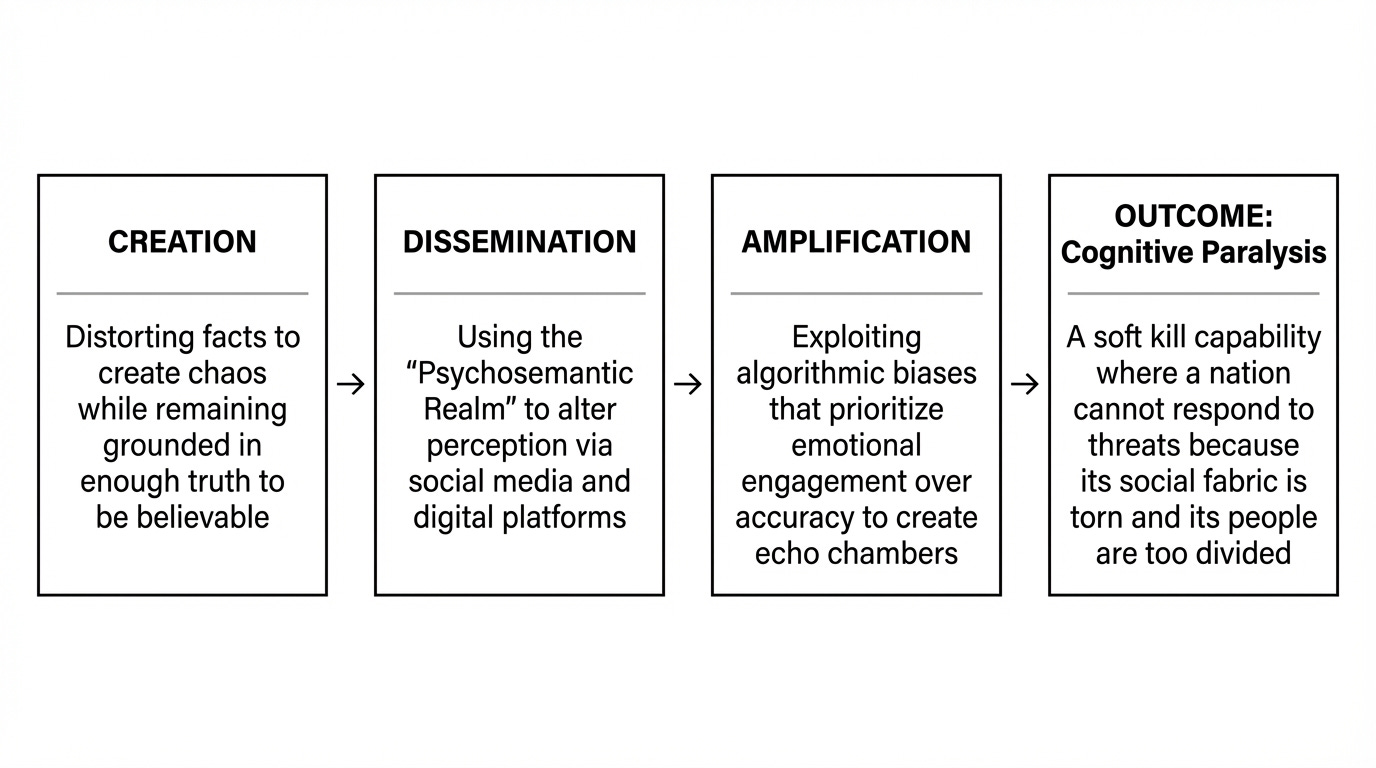
The researchers identified a strategic cycle that enables disinformation to achieve cognitive paralysis: creation (where information is selectively distorted while preserving elements of truth to enhance credibility), dissemination (content distributed through digital platforms targeting specific audiences), and amplification (where algorithmic systems prioritize engagement-driven content, enabling rapid viral spread).
Critically, the study demonstrates that misleading information consistently achieves greater reach than verified content across digital platforms — a pattern driven by algorithms that reward emotionally charged material regardless of accuracy, reinforcing echo chambers and amplifying psychological impact.
Using the Iran-Israel conflict as a case study, the paper documented how “digitally mediated narratives are deliberately constructed and amplified to influence both domestic and international audiences.”
Iranian state outlets and covert operatives produced “a steady torrent of propaganda, overstated narratives and outright disinformation,” increasingly wielding generative AI tools to create realistic imagery.
Tehran Times published a manipulated satellite image purporting to show destruction at Qatar’s Al-Udeid Air Base. Military-aligned outlet Tasnim claimed 650 U.S. troops were killed or wounded in two days — U.S. Central Command confirmed six fatalities.
Semi-official outlet Mehr reported Iranian missiles hit the USS Abraham Lincoln, which CENTCOM stated was neither hit nor targeted.
Iran’s campaign included “flooding platforms such as X, Instagram and Bluesky with targeted postings” featuring AI-generated videos and fabricated footage of strikes on Israeli targets.
Iran’s information warfare operates alongside cyber operations. Palo Alto Networks’ Unit 42 documented an escalation of Iranian-linked activity in March 2026, identifying 7,381 conflict-related phishing URLs across 1,881 unique domains. Iranian-linked groups claimed responsibility for compromising Israeli energy companies, healthcare networks, and payment infrastructure, plus critical infrastructure in Jordan, Saudi Arabia, Bahrain, and the UAE.
The campaign extends to ideological subversion. A March 2026 briefing by the Simon Wiesenthal Center exposed how Iran uses “propaganda and disinformation to promote antisemitic narratives as part of an effort to undermine the West.”
Link: The Mind War Against Israel: How Iran “Weaponizes Truth” in the Digital Age
Hamas Admits: These 10 Strikes on Homes & Tents Killed Combatants by Salo Aizenberg
A common narrative of the Gaza war is that Israel conducted indiscriminate bombing, striking civilian homes, shelters, and tents in humanitarian zones without military justification. Yet no clear, affirmative evidence has been produced showing the IDF deliberately targeted a civilian site absent a military objective.
This narrative nonetheless became central to accusations of
war crimes and genocide. It gained traction in part because Hamas and Palestinian Islamic Jihad (PIJ) systematically operate in civilian dress and embed within homes, mosques, hospitals, and humanitarian zones as part of a human shield strategy. Under these conditions, strikes on legitimate military targets can appear indistinguishable from attacks on civilians, especially in initial reporting.
New evidence has emerged showing that dozens of IDF airstrikes on homes and tents in fact targeted and killed combatants. Recent disclosures by Hamas, PIJ and DFLP, through official statements, affiliated Telegram channels, and martyr notices, have identified their own operatives killed in incidents widely reported as attacks on civilians.
When these admissions are cross-referenced with specific strike reports and contemporaneous local coverage that initially presented the individuals as civilians but now identifies them as combatants, a consistent pattern emerges. Many incidents described as unlawful attacks on homes, shelters, or tents in humanitarian zones were in fact strikes targeting embedded fighters.
The ten cases presented above (now 20 total, there are many more) counter the false claim that the Gaza war was characterized by indiscriminate IDF bombing or even the deliberate targeting of civilians. While initial reports portrayed these incidents as unlawful strikes on civilians in homes and humanitarian zones, subsequent martyr notices and admissions from Hamas and PIJ identify the actual targets.
These disclosures show that the individuals killed in these locations were members of militant groups.
They also reveal a consistent pattern of fighters embedding within civilian environments. As more of these cases are confirmed through the groups’ own statements, the reality of the war becomes increasingly clear that: (1) the IDF conducted deliberate, precise strikes targeting combatants (2) civilians killed were not targeted, but harmed due to their use as human shields by militant groups.
Link: Hamas Admits: These 10 Strikes on Homes & Tents Killed Combatants
Israel/Middle East Related Articles and Analysis
Targeting Iran’s ‘Shadow Fleet’ to Hurt China by Seth Mandel in Commentary
epending on which news sources you consume, President Trump is either giving Iran all the time in the world to respond to U.S. negotiators because he’s in no hurry to resume strikes, or he’s giving them a limited window of a few days before he’s out of patience.…the president seems to be in no particular rush. Perhaps that’s a feint by the president designed to retain the element of surprise. Or, and this might be wishful thinking, it’s because he isn’t thinking about Iran as much as he’s thinking about China at the moment.
On Tuesday, the U.S. interdicted the “stateless” Tifani, a ship with a reputation for helping Iran evade sanctions…The Tifani, the Journal reports, is one of over 500 ships in a so-called shadow fleet critical to China’s ability to import Iranian oil…
Iran believes it can wait out the U.S., leveraging the relentless Western media campaign against the war and the low public approval of the president. If all the regime in Tehran needs to do is survive, it has an advantage over the U.S., which obviously wants more out of this than to merely survive. Iran thinks lowering its expectations will raise the stakes on Trump, and it very well might. If Trump is committed to targeting the shadow fleet, however, the stakes are raised for Iran as well.
And for China. The country is Iran’s top oil customer, so a U.S. blockade of Hormuz also hurts Beijing. But there’s a weakness to this strategy: Iran already has 140 million barrels of oil sitting on ships outside the blockaded zone.
And if China wants Iran to end the war, it will. China is the most important source of cash and missile-supply replenishments for Iran. Putting pressure on China by definition puts pressure on Iran.
A Hormuz-only blockade is only a temporary threat to China. Breaking up the shadow fleet would be a much more permanent wound to the CCP and to Iran. The U.S. is telling China that if global shipping continues to suffer, Beijing will not avoid that suffering.
Instead, it’ll face the dismantling of its carefully crafted system of sanctions evasion, the replacing of which would be time consuming and very expensive.
…there’s more evidence that the U.S. is thinking along these lines: The Washington Post reports that the U.S. intercepted and redirected a couple of ships that had left Iranian ports before the blockade began.
The war in Iran may be far less localized than it initially appeared. The physical targets are still Iranian, but the broader target is—or should be—China’s patience.
The Strait of Hormuz Reverse Uno Card by Gary Brode
Recently, I’ve written that many of President Trump’s critics are making the same error. When Iran closed the Strait of Hormuz, the narrow waterway that previously transported 20% of the world’s oil supply, the price of oil rose. Gas prices in the US have risen in response. Many screamed that this was an obvious move by the Iranian regime and insisted President Trump should have known it was something they’d do. How could he not know?!
Early in the war, Iran closed the Strait which placed economic pressure on the rest of the world. Despite the fact that it was Iran mining the Strait and shooting at the ships that attempted to navigate it, many countries expressed anger at the US and Israel. This was the outcome Iran wanted…Then, the regime decided to allow friendly ships to pass if they paid a fee…This looked like worst-case scenario for the US. Iran succeeded in closing the Strait and causing economic problems all over the world, then found a way to profit from their own actions.
Then, President Trump played his “reverse uno” card. He correctly realized that it wasn’t just the rest of the world that depended on free passage through the Strait of Hormuz, and that it was Iran that had the most exposure. Iran is a big oil producer, and oil exports account for 80% of Iran’s exports, 60% of government revenue, and 25% of its GDP…It turns out that Iran has more economic exposure to this narrow waterway than anyone else.
Iran is close to filling its own storage. Once its oil tanks are full, the regime has two choices, either capitulate and come to an agreement with the US, or to stop producing from its own wells. The problem with the second choice is that it’s difficult to reverse. Stopping production on an active oil well tends to damage it and it’s hard to re-start later…Iran now has a limited amount of time to find a course of action before 25% of its GDP becomes permanently(ish) impaired.
While no one in the US likes paying more for gas, prices were much higher just four years ago in 2022 and around $4/gallon in 2008, 2011, and 2012 when $4 had more purchasing power than it does now. The US is a net energy exporter with an economy that has survived higher prices in the past. Foreign ships are turning away from the Strait of Hormuz and sailing to Texas and other southern US ports to fill up at premium prices. I’m not suggesting that this is great for the US; but rather, that the US is well-suited to manage the situation while Iran is about to be faced with a massive long-term problem.
Finally, Iran maintains control of the country using extensive human infrastructure. There are police everywhere monitoring protests, internet usage, the attire of citizens, and the hair of Iranian women. That level of control is expensive and the government just lost 60% of its revenue. I’m wondering how long they’ll keep doing their jobs without paychecks.
I don’t know how this conflict will end. What I do know is that President Trump and the US Navy have turned Iran’s biggest strategic strength into a giant weakness.
Casualties: 13 Americans; 39 Israelis (+2)
United States
No additional causalities to report.
Israel

Nesiah Karadi, 11, succumbed to her wounds on Friday following more than three weeks of fighting in the intensive care unit after she was struck by an Iranian missile in Bnei Brak on Passover eve, according to the Jerusalem Post. The April 1 strike took place hours before the Passover holiday and wounded 13 other people, including the girl’s father, who sustained moderate injuries. According to the Times of Israel, a first responder told Hebrew media at the time that the father, a volunteer with the Magen David Adom ambulance service, applied first aid to his daughter before losing consciousness when medics arrived.

Sgt. Idan Fooks, 19, of the 7th Armored Brigade’s 77th Battalion, from Petah Tikva, was killed in a Hezbollah explosive drone strike in southern Lebanon on Sunday.