Israel Update
US Service Members KIA: 13; Israelis Killed (+1): 40
Watch
On Wednesday, a Somalia-born British citizen stabbed Shloime Rand, 34, and Moshe Shine, 76, in the heavily Jewish neighborhood of Golders Green, in north London. Both men had left morning prayers at a synagogue before the attack. The terrorist has now been charged with two counts of attempted murder and one count of possession of a bladed article in a public place in relation to the attack

[WOW - MUST WATCH] Rabbi Doron Birnbaum shares how he learned of the terror attack in Golders Green whilst visiting Auschwitz: “The conversations we are having around family tables are the same conversations they were having in 1935.”
At yesterday’s University of Michigan graduation, Professor Derek Peterson thanked anti-Israel protesters (i.e. terrorist sympathizers) for 2 years of campus chaos (credit: StopAntisemitism)
Antisemitism Related Articles and Analysis
The Moral Mob and the Human Rights Industrial Complex by Joel Finkelstein, Shawn Chenoweth, and Judea Pearl in Newsweek
As American forces engage Iran, a question worth asking in every situation room is going unanswered: How did a meaningful share of the American public come to view the regime we are fighting more favorably than our own country on human rights?
The accusations that shape this perception do not stop at America’s allies. They follow American money, American policy and American institutions wherever they go…There is a pattern underlying this, and it begins not with disagreement about values or facts but with a confusion about cause and effect.
In recent years, the language of human rights has become detached from the evidentiary discipline that once governed it. Terms like genocide and famine are increasingly deployed in advance of established facts, as instruments for shaping reality rather than describing it. The accusation arrives first.
When cause and effect are reversed—a common human fallacy—explanation gives way to delusion. Outcomes are treated as proof of intent. Moral judgment becomes untethered from the processes that produce the harm it purports to address.
New research from the Network Contagion Research Institute (NCRI) and Rutgers University confirms this pattern is measurable. A meaningful subset of Americans now rates authoritarian states more favorably than democratic ones on human rights, including states openly hostile to the U.S.
Two institutional forces are producing this outcome.
The first operates through international institutions and advocacy organizations that have accumulated enormous authority over the language of human rights…When the United Nations declares famine, governments mobilize and courts take notice. When that declaration later turns out to rest on bad data and buried evidence, no correction follows. The damage is done. The funding has already moved.
The second force operates at the street level, where organized protest ecosystems amplify the accusations that institutional bodies generate. Documented research has traced how the Singham network, a global infrastructure with documented financial ties to Chinese Communist Party (CCP)-affiliated entities, directed funds and narratives into American activist organizations. The protest activity that followed was, in significant part, engineered.
The institution names the violation. The protest ecosystem amplifies it. The accused defends itself. And the regime actually responsible recedes from scrutiny.
In August 2025, the U.N. famine authority declared a famine despite [Johnnie Moore, chairman of the U.S. State Department-backed Gaza Humanitarian Foundation] Moore’s operation actively delivering food. A forensic audit by NCRI found the declaration rested on a trend derived from six data points while a dataset of 15,000 children showed malnutrition below the declaration’s own threshold. Subsequent assessments found the declaration had significantly overstated conditions. No correction followed. The damage was done.
The human cost became visible three months before that declaration. In May 2025, a gunman killed two embassy staffers outside a Washington museum. He told police he acted for Gaza. His manifesto cited genocide and famine.
He had a prior association with organizations closely linked to convenors of the protest network traced to the Singham infrastructure.
The famine narrative that radicalized him was later found to have been significantly overstated. The two people killed by his radicalization remained dead. In North Korea and Sudan, hunger functions as an instrument of state control on a far greater scale. Declarations and protests have not followed with comparable urgency.
Authoritarian states are not passive beneficiaries. Each deployment of genocide or famine against American-backed targets degrades the credibility of the terms, consumes public attention and provides cover for documented abuses elsewhere.
Once the causal structure of an argument is inverted, the conclusions it generates cannot be corrected from within. The accusation travels ahead of the evidence and organizes whatever evidence follows.
The famine declaration was not a neutral scientific assessment. It was a methodological failure with geopolitical consequences that undermined a functioning American initiative and raised unresolved questions about foreign-funded domestic operations under the Foreign Agents Registration Act (FARA).
The research identifies a single primary entry point. It is anti-Zionism: a cause that appears to have nothing to do with America and everything to do with a conflict elsewhere. The appearance of being unrelated to America is what makes it effective.
What we are observing now operates in precise inversion. The sacrifice is the nation itself. Belonging is demonstrated by renouncing it, by treating national identity as moral contamination and replacing it with allegiance to a universal order.
And as the data shows, the destination is the same. An inability to evaluate one’s own country honestly. Measurably warmer feelings toward adversarial powers. A willingness to accept extreme accusations without evidentiary scrutiny because those accusations are doing social work, not intellectual work.
[ALARMING BUT NOT SURPRISED] Three Years After October 7, Anti-Semitic Violence Is Still Rising by Seth Mandel in Commentary
Post-October 7 anti-Semitism seemed primed to follow the usual pattern, in which certain metrics of anti-Semitism will improve after the surge and others will level off at the crest of the surge. So all the metrics are considered in light of the assumption that the surge will fade as the Hamas attacks get further in the rearview mirror.
When Tel Aviv University released its annual report on worldwide anti-Semitism for the year 2025, the main headline was that more Jews had been killed in anti-Semitic incidents (20) than in any year in over three decades.
To be Jewish in some parts of the world now is to feel more like a target than ever…Three years after October 7, violent anti-Semitism is still rising across parts of the West.
France, the report notes…“The number of incidents involving physical violence reached 126 in 2025, up from 106 in 2024, 85 in 2023, and 43 in 2022.”
The report notes that incidents of vandalism are also down slightly. But the increase in violent incidents was greater than the decrease in vandalism, suggesting that Jew-haters in France are changing tactics and getting more dangerous. Again, this is something the overall number of incidents won’t tell you.
Canada, the report—which relies on country-specific sources—has only the number of overall incidents. And that one’s not good: About 600 more in 2025 than the year before; 2024 also exceeded 2023. Again, wrong direction
The news isn’t great in the United Kingdom either. The number of overall anti-Semitic incidents in the UK in 2025 was higher than in 2024 (though lower than in 2023). The Community Security Trust keeps a category of “extreme violence,” and there were four such incidents in 2025—double the number of the year before.
In Australia, as one might expect from reading recent headlines, anti-Semitic incidents increased in 2025 over 2024. As for violence, 15 were murdered in the Bondi Beach massacre in December.
Belgium’s anti-Semitism-monitoring organization recorded a massive increase in overall anti-Jewish incidents, from 129 in 2024 to 232 in 2025. Physical assaults also increased, as did vandalism.
Italy saw a rise in overall anti-Semitic events and assaults
In Spain, too, anti-Semitic incidents increased—an unsurprising result considering the amount of time and effort the government of Pedro Sanchez spends demonizing the Jewish state.
In Norway, overall incidents went down, but acts of violence increased from one to four.
The only somewhat bright spot—and that is really stretching the description—in this group was Germany, which saw fewer overall incidents and fewer acts of anti-Semitic violence. It should come as no surprise that the Western country in which the numbers are at least moving in the right direction is also the only place in Europe that has made an effort to combat anti-Zionism and demonization of Israel at the national level.
We can stop pretending that the constant vilification of the world’s only Jewish state has no clear and dangerous consequences for the Jews of the world…Anti-Semitism in the West continues to defy predictions in the worst way possible.
Link: Three Years After October 7, Anti-Semitic Violence Is Still Rising
Moral Inversion and the Iran War by Zack Dulberg and Adam Louis-Klein in The Free Press
A recent poll found that among Democrats under 50, Iran is viewed more favorably than Israel—a data point that would have been unthinkable a generation ago, and one that demands explanation. The Iran war has revealed that a surprising contingent on both the left and right express sympathy—or even open support—for the Iranian regime.
How is it possible that a regime defined by repression of freedoms at home—subjugating women, dissidents, LGBT, and others—and genocidal incitement abroad, could become an object of admiration among people who claim to advocate for human rights?
A recent study we carried out at the Network Contagion Research Institute (NCRI)…found that “participants who expressed greater agreement with anti-Israel ideology more strongly endorsed Soviet and Nazi propaganda that featured both generic antisemitic tropes and anti-Israel tropes, had more left-wing (“progressive”) authoritarian attitudes, and rated the human rights records of some of the world’s worst human rights violators more favorably than those who expressed lower levels of agreement.”
Anti-Zionism, a worldview that casts Israel as the pinnacle of injustice while presenting itself as moral resistance, predicts what we call Moral Inversion Syndrome: a pattern in which the perceived human-rights standing of Western democratic states declines relative to that of authoritarian regimes.
The study asked a representative online sample of Americans to rate the human-rights records of various countries and correlated those ratings with traits measured by validated psychological scales. According to our data, the more one expresses essentialist prejudice against Israel, or Jews, the more distorted one’s moral judgment becomes in general.
Those with strongly anti-Zionist attitudes (as well as traditionally antisemitic ones; the two attitudes were correlated though not identical) often place oppressive regimes such as Iran, China, or North Korea on the same moral plane as liberal-democratic states like the United States or Australia. And Israel is seen as the worst of the worst.
Since 1948, anti-Zionists have formulated their cause as an inversion of the moral and legal right of the Jewish people to self-determination, which was recognized by the United Nations at Israel’s founding.
But our data clearly shows that anti-Zionism is an ideology that violates the human-rights order it claims to defend. By turning Israel into the scapegoat for modernity’s most foundational crimes—colonialism, apartheid, and genocide—it in fact undermines the very architecture that was constructed to prevent those crimes.
Consistent with this pattern, our study finds that when respondents were shown Soviet anti-Zionist propaganda images—depicting Israelis as Nazis or linking the Star of David with dollar signs and swastikas—those who more strongly endorsed the images were more likely to make morally inverted human-rights judgments.
In the present day, the UN can hardly bring itself to condemn Iran’s targeting of Israeli civilians using cluster munitions, yet has no hesitation in establishing commissions to accuse Israel of genocide, collapsing the distinction between civilian casualties and the intentional destruction of a group.
The study also suggests that the problem goes beyond just how Israel is perceived.
If anti-Zionism—whether in its left-wing form or in the increasingly visible right-wing variant promoted by figures such as Tucker Carlson—constructs Israel as an all-encompassing symbol of political evil in the contemporary order, then the Iran war takes on a more fundamental meaning. It begins to appear as a confrontation between the possibility of moral judgment and an ideology in which the very distinction between right and wrong has been turned upside down.
Israel/Middle East Related Articles and Analysis
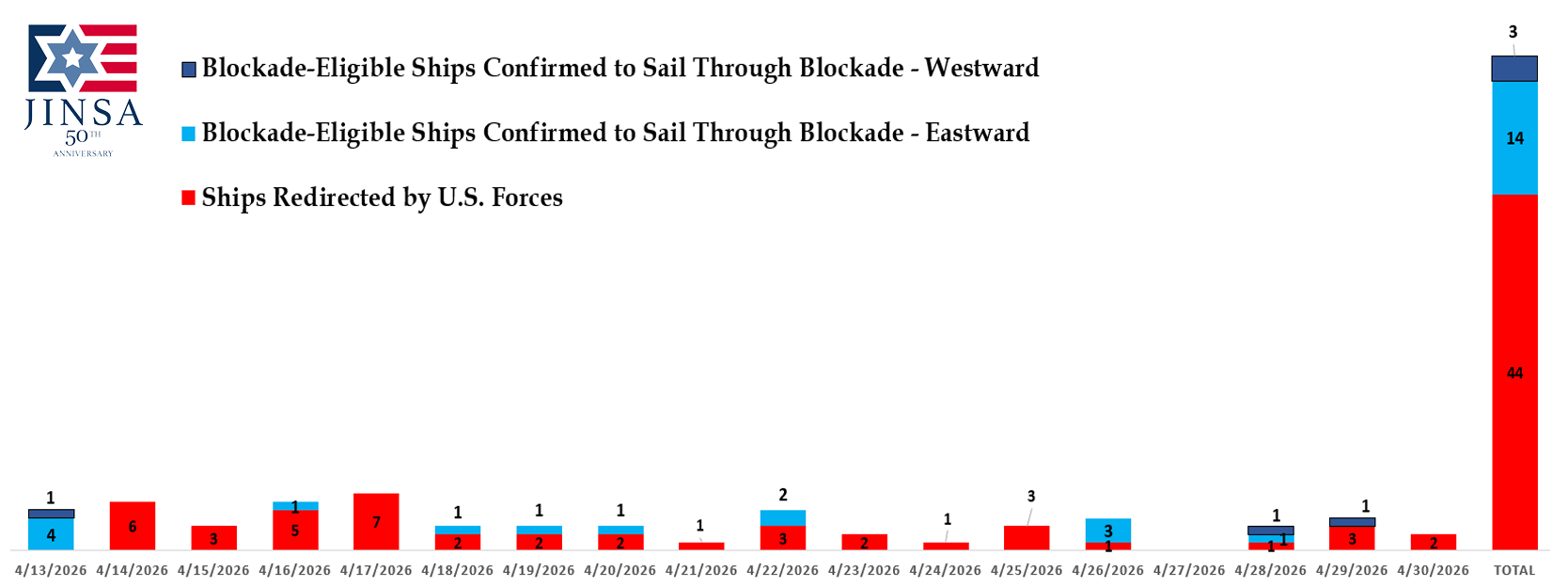
Turning Tides: U.S. Blockade Enforcement Exceeds Iranian Evasion by Yoni Tobin with Jewish Institute for National Security of America (JINSA)
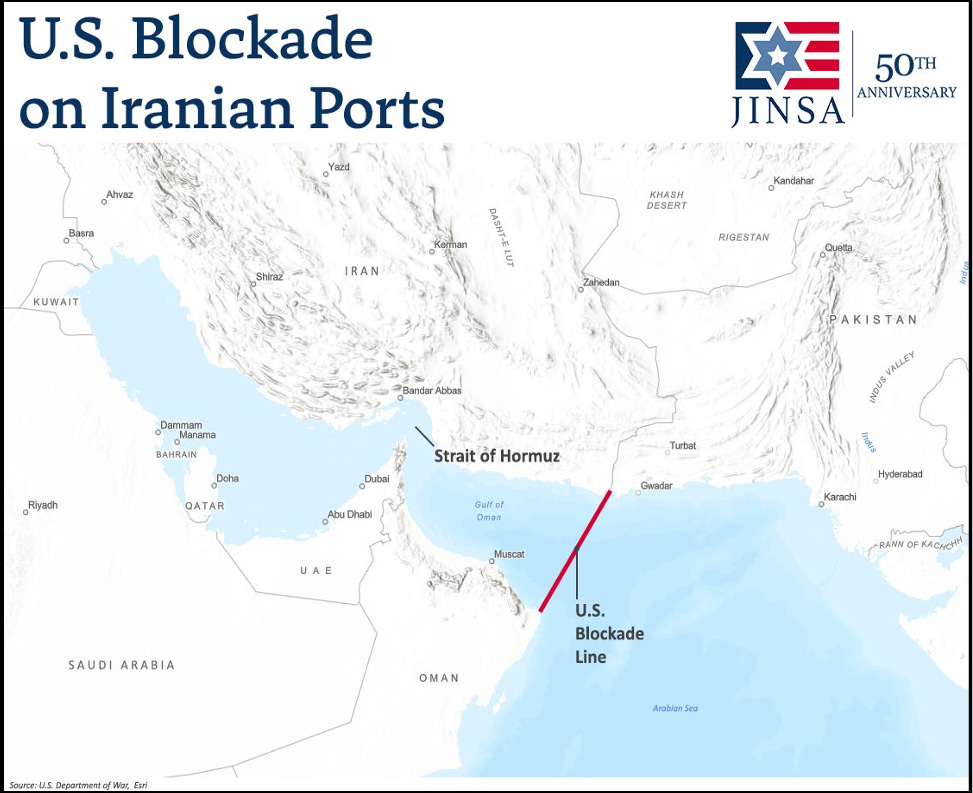
We have found that just 17 blockade-eligible ships crossed the blockade line as of April 30—and, of the 17, around a quarter did so on the blockade’s first day, suggesting early enforcement issues that have since been resolved. These figures, like all other public estimates, exclude small boats like fishing vessels and fast attack craft. However, a range of factors—including ships turning off their transponders or falsely listing their flagged-nation, port of origin, or intended destination—can complicate vessel tracking even in normal circumstances.
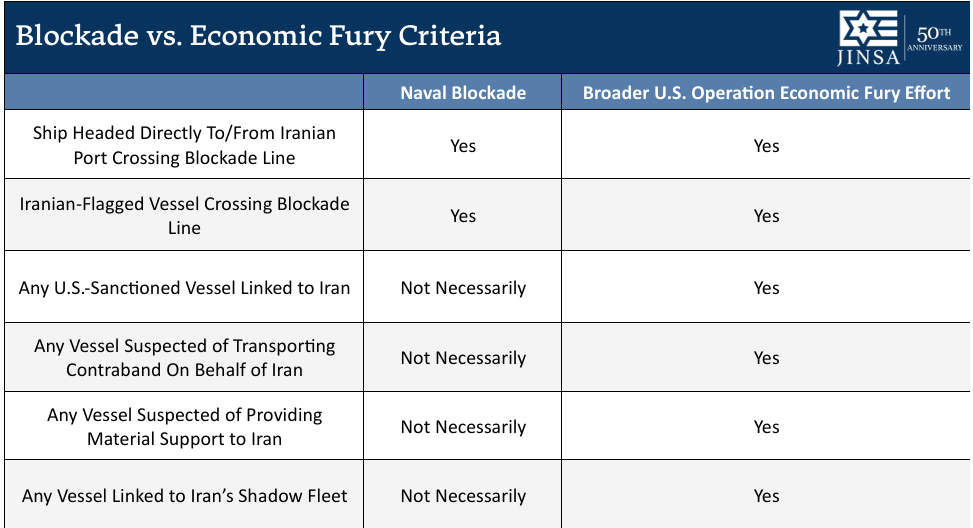
Overall, JINSA’s data review suggests the blockade and broader U.S. maritime interdiction strategy have been effective—if often misunderstood.
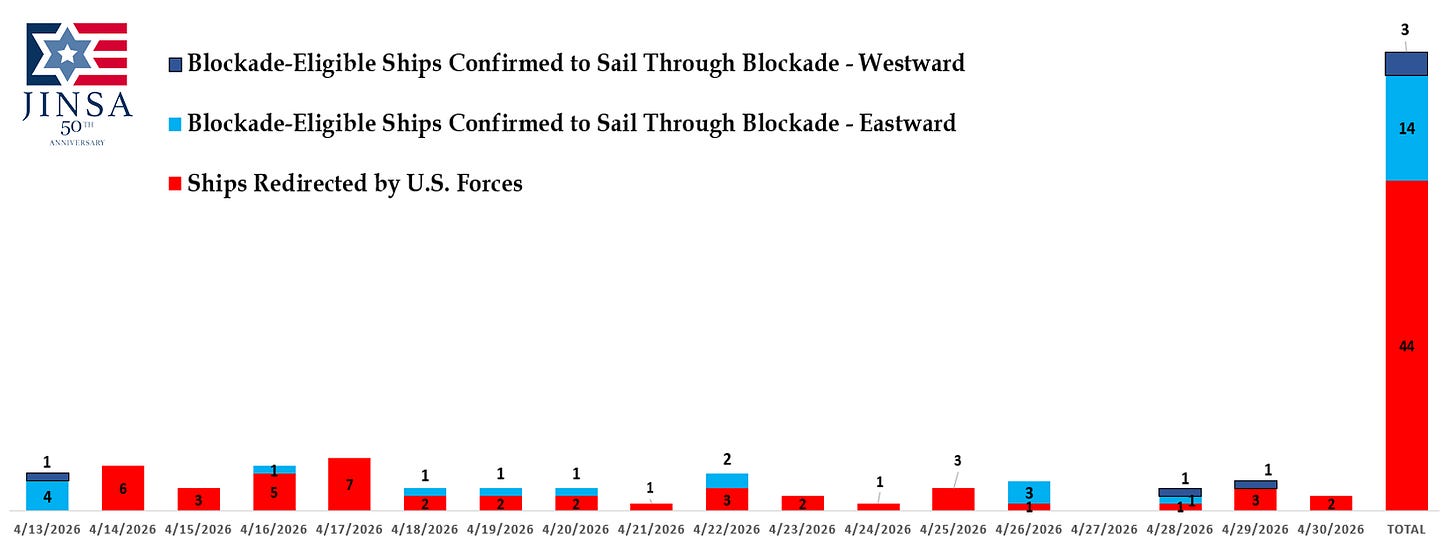
American forces have redirected 44 vessels seeking to breach the blockade since April 13, and seized another one. They also seized at least an additional two non-Iranian vessels transporting Iran’s crude oil in Asia.
By contrast, just 17 eligible ships, a fraction of that total, breached the blockade line. Notably, none of them were oil or gas tankers; all the ships that escaped the blockade so far were bulk cargo carriers, including some small ones of little obvious utility to the Iranian regime.
The blockade, other U.S. interdiction operations, and the broader economic warfare campaign labeled Operation Economic Fury have a preventative effect that is not reflected in any shipping data. These measures deter an unknown, though nonzero, number of ships from leaving Iranian ports in the first place—depriving the regime of its financial lifeline.
These operations constrict the regime’s ability to import weapons components, assembled weaponry, inputs for missile fuel, cash, and other items from its patrons in Beijing and Moscow. So long as the operations continue, the Islamic Republic will have few, if any, options for reversing its current economic and military weakness.
Link to Full Report: Turning Tides: U.S. Blockade Enforcement Exceeds Iranian Evasion
Here’s how to crush Tehran in three moves by Richard Goldberg in The New York Post
President Trump has the upper hand. His best path forward is to pursue three lines of effort in parallel:
Sustain the blockade and accompanying economic warfare to destabilize the regime’s hold on the state;
remake the world in America’s energy dominance image to mitigate long-term price impacts while undermining China’s global ambition to defeat the United States;
and order the US military to forge a path through the Strait of Hormuz to restore freedom of navigation on our terms not Tehran’s.
Whether Iran’s oil storage completely runs out in a day or a month, Iran is no longer exporting oil — the lifeblood of its economy — or petrochemicals, steel or any other product at a level needed to keep the government afloat, banks capitalized and employees paid.
The currency is in free fall, domestic prices are skyrocketing, reserves are being drained and escape hatches — sanctions evasion routes the regime typically relies upon — are getting closed soon after they open. A gasoline shortage comes next.
Every bank account — and crypto wallet — where the regime has cash is being frozen.
Sanctions evasion trails are being tracked down with calls being made to the highest levels of foreign governments warning of dire enforcement actions to come without immediate action – from Baghdad to Islamabad to Beijing. There is zero doubt that the trajectory for the regime in Tehran is state collapse.
…by imposing a continued shutdown of the internet and controlling the flow of information, the IRGC rulers use cognitive warfare to alter our perception of that reality, and to make it incredibly challenging to understand how much time they have left.
On the domestic energy front, every feasible way to expedite refinery expansion and modernization in the United States should be fast-tracked. Internationally, every new oil project an American company has ever wanted to pursue should get the full backing of the administration.
In the end, if American — and hopefully allied — naval and air forces can clear and defend a narrow path for even a limited tanker flow to emerge from the Gulf, while still sustaining Operation Economic Fury, it’ll be checkmate for the paper ayatollah.
China’s Machinery in Iran Meets Washington’s Economic Fury by Zineb Riboua
“The Strait of Hormuz,” Secretary of State Marco Rubio told Fox News this week, “is an economic nuclear weapon.”…The US Navy’s blockade of the Strait denied the IRGC that instrument before it could be used, and Operation Economic Fury now ensures the failure compounds, turning against Tehran the same economic pressure Iran spent decades positioning itself to inflict on the world.
What most ceasefire commentary has missed is that the military campaign's pause does not mean the conflict has paused…
For years, the IRGC sustained itself through shell companies, rotating vessel identities, and shadow banking corridors that kept oil revenue flowing far from formal financial channels, turning every prior sanctions round into a temporary inconvenience absorbed and rerouted within months.
Washington kept targeting individual nodes while leaving the broader network intact, which gave Tehran reasonable confidence that Epic Fury’s ceasefire, like every pause before it, would open another window for recovery.
That calculation is wrong this time, because the cost of each passing week compounds rather than eases, with Treasury’s action targeting the evasion architecture itself rather than its individual components, ensuring that what Tehran reads as time purchased is in fact institutional capacity being permanently stripped away.
That architecture survived as long as it did for one reason: China built the infrastructure to sustain it, and Xi Jinping made that a deliberate strategic choice on three levels.
First, Beijing built the financial plumbing, developing methods for shadow banking, obscuring the origins of Iranian crude, rotating ship identities, and layering payments through third-country intermediaries.
Second, its teapot refinery sector absorbed most of Iran’s oil exports to China, conducting those transactions through the US financial system in dollar-denominated deals and providing the IRGC with the hard currency needed to fund missile, drone, and weapons transfers to regional proxies.
Third, and most critically, Xi used Iran as a rehearsal space, refining evasion techniques he intended to deploy on a far greater scale if Washington’s pressure ever turned directly toward China's core interests.
The volumes document exactly how deeply that relationship ran. The IRGC operated a rotating fleet of tankers under falsified identities to conceal Iranian crude shipments to Chinese buyers…The arrangement served Beijing on both ends: Chinese refiners purchased Iranian crude at steep discounts unavailable on open markets, while every successful evasion transaction simultaneously stress-tested the financial infrastructure Xi intended to activate over Taiwan.
However, the US Treasury’s latest action forecloses that confidence by sanctioning 35 entities and individuals operating Iran’s shadow banking architecture, simultaneously targeting 19 shadow fleet vessels, and putting every firm paying IRGC tolls for passage through the Strait of Hormuz on notice.
The stated objective of Operation Economic Fury is to coerce the IRGC into surrendering its nuclear program and abandoning its revolutionary ambitions across the region, an objective whose outcome remains uncertain.
What is already underway, as a direct consequence of pursuing it, is the dismantlement of the laboratory Xi spent two decades building, with Washington systematically mapping, documenting, and countering the instruments produced there.
What appears to be a pressure campaign against the IRGC and another against Beijing’s financial architecture is, in fact, a single operation.
Link: China's Machinery in Iran Meets Washington's Economic Fury
Casualties: 13 Americans; 40 Israelis (+1)
Israel: 25 civilians/15 IDF (942 IDF casualties since October 7th)

Sgt. Liem Ben Hamo, 19, of the Golani Brigade’s 13th Battalion, from Herzliya was killed, and three were moderately wounded in two Hezbollah explosive drone attacks in southern Lebanon on Thursday morning, as another drone launched by the terror group struck an artillery position on the border, wounding twelve other troops, according to the IDF and Times of Israel.
United States
No additional causalities to report.