Israel Update
US Service Members KIA: 13; Israelis Killed (+2): 37 (24 civilians/13 IDF)
Watch
Uvda (considered Israel’s version of 60 Minutes) broadcast this never-before-seen footage from October 7th: This is unprecedented footage like nothing we've ever seen: the moments when members of Kibbutz Be'eri enter the hangar adjacent to the kibbutz. Soldiers carry children in their arms, and the residents now see each other for the first time – after being rescued from the fire, and the hangar's cameras document it all: the pain, the camaraderie, and the kindness.
The program also aired: This is the first hour of that Sabbath morning, and this is what was captured on the cameras at the Dor Alon gas station, Kfar Aza: a group of people who find themselves together, in a small Alonit store, at the moment when the realization lands—no one is coming to rescue them and only they can save themselves, perhaps.
Situational Update
From the Institute for the Study of War (ISW): Islamic Revolutionary Guards Corps (IRGC) Commander Major General Ahmad Vahidi and members of his inner circle have likely secured at least temporary control over not only Iran’s military response in this conflict but also Iran’s negotiating position and approach within the past 48 hours.
The IRGC Navy attacked several commercial vessels on April 18 and declared that no vessel of “any type or nationality” is permitted passage through the strait, a reversal of Iranian Foreign Affairs Minister Abbas Araghchi’s announcement on April 17 that the strait was “completely open” to commercial traffic. IRGC-affiliated media also announced on April 18 that Iran has not agreed to participate in another round of negotiations with the United States due to “excessive” US demands.
The IRGC’s consolidation of control over Iranian decision-making indicates that the Iranian political officials currently negotiating with the United States do not have the authority to independently determine Iran’s negotiating positions.
President Trump warned that the ceasefire may not be extended if no agreement is reached by April 22
Israeli military correspondent Doron Kadosh reports on a recent IDF briefing:
IDF warns the political echelon: Iran is arriving very weak and battered to negotiations - it must not be given any concessions. The IDF believes it is essential to stand firm on several principles in the negotiations - the enriched uranium must be removed from Iran, Iran must not be allowed to enrich uranium indefinitely (and not just for a limited number of years), and the unfreezing of funds must not be permitted, as it would bring significant money to the Iranian regime and strengthen it.
The IDF assesses: If the issue of ballistic missiles is not addressed within the framework of the agreement - within a very short period of a few years, Iran will be able to rebuild thousands of ballistic missiles, if it decides to invest in it.
The IDF clarifies: From the outset, we assessed for the political echelon that the chance of toppling the regime in Iran is low. It is not possible to topple a regime with airstrikes - but there are now cracks and breaches in the Iranian regime.
Iran launched a total of about 1,400 ballistic missiles in the campaign. Only 39% of them - were launched at Israel. The rest - at countries in the region and the Gulf. The interception rates of the missiles - 84%, lower than in "Operation Iron Swords." The reason - extensive Iranian use of cluster missiles, which are harder to intercept. More than 70% of the missile impacts in Israel are from cluster missiles.
The IDF estimates the damage to industries in Iran at about $100 billion, and believes it will take Iran several years to rehabilitate them.
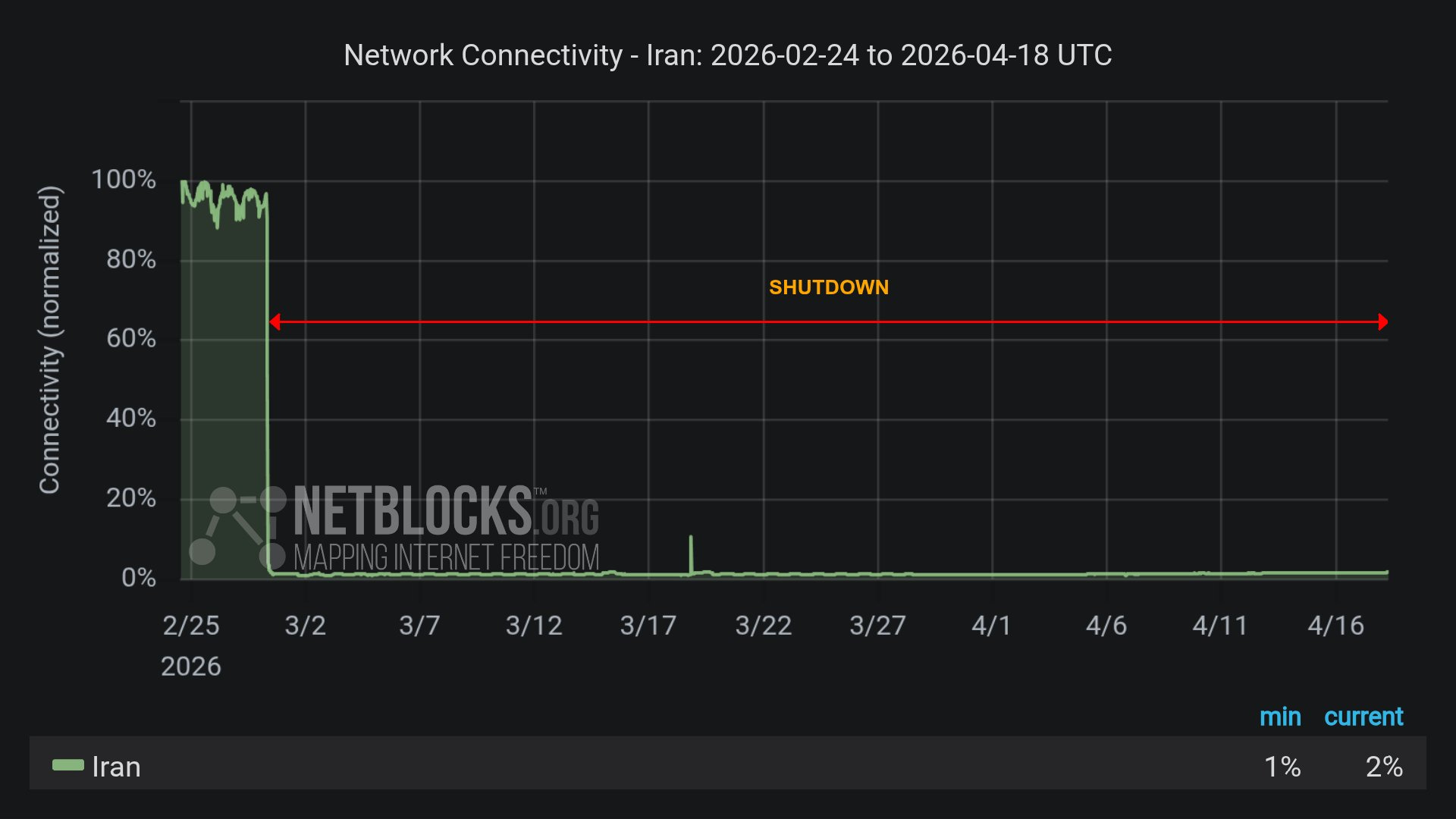
Iran has now been isolated from the global internet for seven weeks with the digital blackout entering its 50th day after 1176 hours. Metrics show the measure, unprecedented for a connected society, continues to the detriment of most Iranians' livelihoods and human rights.
Israel/Middle East Related Articles and Analysis
America’s Arab Allies Are Making History by Seth Mandel in Commentary Magazine
Facilitated by Marco Rubio and his State Department team, Beirut and Jerusalem held their first face-to-face talks in decades and agreed to continue meeting.
The Trump administration appears to realize the importance of this breakthrough, if the official statement from Foggy Bottom is any indication:
“…The United States expressed its hope that talks can exceed the scope of the 2024 agreement and bring about a comprehensive peace deal. The United States expressed its support for Israel’s right to defend itself from Hizballah’s continued attacks. The United States affirmed that any agreement to cease hostilities must be reached between the two governments, brokered by the United States, and not through any separate track.”
That last sentence is another encouraging sign. Iran does not get to speak for Lebanon; it must watch from the sidelines as Israel and Lebanon discuss ousting Tehran’s proxies from sovereign Lebanese territory.
Lebanon’s participation in this means that the Trump administration offered it attractive incentives to be involved and almost surely convinced Beirut that U.S. forces will not cut and run from the Gulf, even as the administration negotiates a cease-fire with Iran.
The Abraham Accords altered the region’s diplomatic status quo and gave Arab countries a new path forward. Today’s meeting suggests that Lebanon is willing to follow down that path.
Despite the fever dreams about Israel supposedly controlling American policy, the Saudis appear to have been the most enthusiastic cheerleader of the manhandling of Iran’s criminal regime. The other Gulf Arab states have reportedly also been encouraging the president to finish the job. This makes sense: Israel has the capability to continue hitting Iran when necessary, but the Arab states are dependent on the Western alliance to keep Iran down.
And the U.S. should reward their trust in us. Lebanon, for example, is among the weakest central governments in this crew. It is also now the most vulnerable to Iran if the U.S. doesn’t follow through, because Hezbollah is far from dead.
It would be catastrophic to coax Lebanon into a public anti-Iran stance and diplomatic engagement with Israel only to later cut them loose.
Having the Arab states look West instead of East is a strategic boon that is worth American commitment.
Israel-Lebanon ceasefire opens a window - but Hezbollah still holds the door by Herb Keinon in The Jerusalem Post
Israel and Lebanon are talking, which is very good. But symbolism is not substance, and symbols do not bring quiet and normalcy to residents of the North.
The more honest way to understand what unfolded this week is not as a breakthrough, but as the opening of a narrow and uncertain window, perched somewhere between the truly historic and the illusory.
Israel and Lebanon can talk all they want, but if Lebanon cannot force its will on Hezbollah, then what is it worth?
So it is reasonable to ask: if the Lebanese government cannot even implement an order to expel a diplomat it itself declared persona non grata, how in the world is it going to disarm Hezbollah?
The Lebanese government may have the will to reach an accommodation with Israel, but what it lacks – glaringly – is the means to carry it out.
For years, the problem has not been hard to identify: Hezbollah. What has been less clear is whether Lebanon itself saw it the same way. What emerged this week in Washington is not a new diagnosis, but a potentially new alignment – Israel and elements of the Lebanese government, at least rhetorically, pointing to the same source of instability.
What this means is that Israel may have found a potential partner in Lebanon that views the issue in the same vein. That is the good news. The bad news is that the Lebanese government, under President Joseph Aoun, may be a partner, but it is not necessarily an enforcer.
Tellingly, the talks went ahead in Washington despite adamant opposition from both Hezbollah and Iran, with Hezbollah leader Naim Qassem warning that “proceeding with the talks would represent capitulation and surrender.”
And here the central contradiction becomes clear. The party holding many of the cards – Hezbollah – is not at the table, is not participating, rejects the process, and continues to fire on Israel. The talks, in essence, aim to solve a problem controlled by an actor outside the diplomatic framework.
By pointedly separating the Israel-Lebanon track from its parallel negotiations with Iran, Washington wants to redefine the diplomatic arena, treating Lebanon as a sovereign state, not just an extension of Iran’s regional network.
The broader goal is clear: to begin, however gradually, prying Lebanon out of Iran’s orbit.
These talks are both significant and limited. Significant because they signal a shift in how the problem is understood. Limited because the solution depends on forces not present at the table.
The breakthrough, if there is one, is not that Israel and Lebanon are talking. It is that, for the first time, they may be talking about the same problem.
Still, no one should hold their breath. After all, this is a country where the government can declare Iran’s ambassador persona non grata, set a deadline for his departure, and then watch as he completely ignores the order. This incident is not some side story; it is the story – a reminder of where power in Lebanon still lies, and of how difficult it will be to shift it.
Link: Israel-Lebanon ceasefire opens a window - but Hezbollah still holds the door
Antisemitism Related Articles and Analysis
Following Bernie Sanders’ lead, 40 Senate Democrats vote against arms sales to Israel by Marc Rod with JewishInsider
Most of the Democrats in the Senate — 40 in total, including some traditionally pro-Israel lawmakers — voted on Wednesday evening for a measure led by Sen. Bernie Sanders (I-VT) that aimed to block sales of bulldozers to Israel, with 36 of them also voting to advance a second Sanders-backed resolution to block sales of thousands of 1,000-pound bombs.
The votes are a striking statement of the extent to which anti-Israel sentiment has become mainstream in the Democratic Party. Just seven members of the Democratic caucus voted against both measures.
Every Senate Democrat rumored to have presidential ambitions voted to block both arms sales.
Senate Minority Leader Chuck Schumer (D-NY) and Sens. Kirsten Gillibrand (D-NY), Jacky Rosen (D-NV), Catherine Cortez Masto (D-NV), Richard Blumenthal (D-CT), John Fetterman (D-PA) and Chris Coons (D-DE) were the only Democrats to oppose both resolutions.
Of the Jewish senators, 7 out of 10 voted to block a sale of bulldozers to Israel. Michael Bennet, Jon Ossoff, Bernie Sanders, Brian Schatz, Adam Schiff, Elissa Slotkin, Ron Wyden. Voting no: Blumenthal, Rosen, Schumer
Link: Following Bernie Sanders’ lead, 40 Senate Democrats vote against arms sales to Israel
[REPORT] From Tehran to Tampa: Iranian Proxy Networks Operating Through Florida’s 501(c)(3) Sector by the Network Contagion Research Institute (NCRI)
As the United States confronts Iran's expanding proxy architecture across the Middle East, this report documents a dimension of that challenge that has received insufficient regulatory attention: the degree to which U.S.-based civil-society infrastructure has been used to platform, sustain, and confer legitimacy upon individuals tied to Iranian-backed proxy organizations operating domestically.
This report examines a network of nonprofit, religious, and advocacy organizations operating in and connected to Florida that show repeated documented overlap with individuals convicted of terrorism-related offenses, designated under U.S. sanctions authorities, or publicly associated with Hamas, Palestinian Islamic Jihad, and broader Iran-aligned influence ecosystems.
Key Findings:
Florida courts removed a state restriction as Iran-linked influence risks persist. Recent rulings struck down Florida laws that had been used against CAIR-related organizations, removing one state-level enforcement tool even as the record reflects continued overlap among Florida nonprofits, convicted terror offenders, Hamas officials, and Iranian regime-linked figures.
A convicted Palestinian Islamic Jihad (PIJ) facilitator built a Florida network that overlaps with Iran’s proxy ecosystem.
A sanctioned PIJ leader held a leadership role in a Tampa mosque.
Network actors platform Hamas officials and Iranian regime-linked figures. Individuals tied to this network have hosted events featuring Hamas officials, sanctioned operatives, and Iranian regime-linked figures…indicating that the relevant Florida-based ecosystem overlaps with the broader Iran-aligned "resistance" sphere rather than stopping at Palestinian militancy alone.
Florida nonprofits provide support, legitimacy, and continuity across the network.
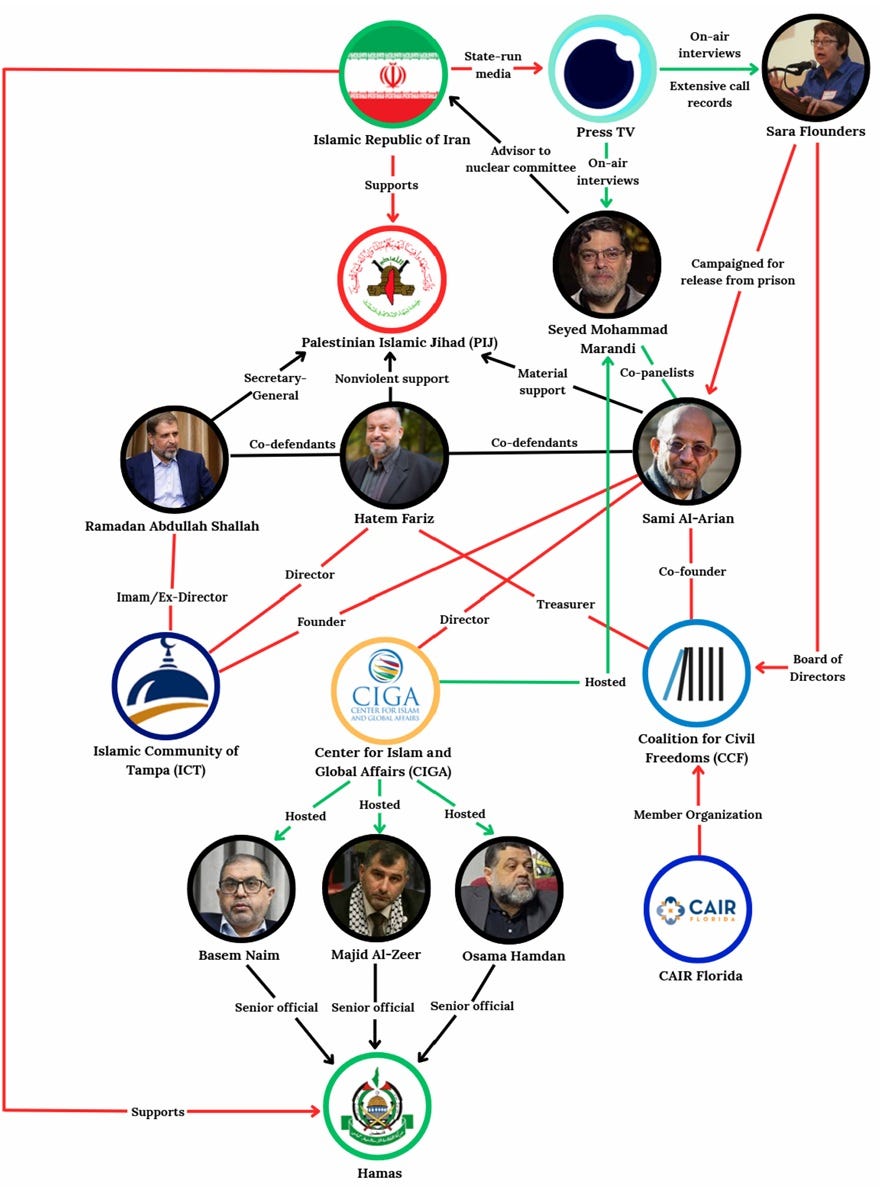
Assessment: Florida’s nonprofit sector presents a permissive environment for Iran-aligned proxy influence. Tax-exempt and allied institutions have provided platforms, sponsorship relationships, financial support, or reputational cover to actors tied to PIJ, Hamas, and overlapping Iranian regime-linked influence ecosystems, creating a domestic risk environment for the amplification of extremist narratives and for downstream compliance exposure.
The significance of this structure is that it documents a domestic ecosystem in which actors tied to PIJ, Hamas, and Iranian regime-linked influence networks can access institutional platforms, donor audiences, and reputational reinforcement through Florida-based organizations. That combination of overlap, continuity, and legitimacy is what makes the Iran angle analytically central rather than incidental.
America Didn’t Go to War for Israel by Avi Mayer in Jerusalem Journal
Let us state the obvious: Yes, Israeli leaders have long identified the Iranian regime and its nuclear program as a threat to Israel’s existence and have openly discussed the possibility of military action to remove that threat.
Iranian leaders have consistently called for Israel’s destruction and have created a network of terrorist proxies dedicated, in both word and deed, to achieving that goal. A weakened regime — or a new Iranian government altogether — would certainly be in Israel’s national interest. All this is true. But it doesn’t explain why the United States chose to go to war.
Put simply, no president — especially this president — would enter a war that may well define his presidency to satisfy another country’s interests. And while Israeli input may have contributed to President Trump’s decision, so did a host of other factors, including pressure from multiple allies in the region, the advice of senior administration officials and advisors, assessments by the Defense Department and intelligence agencies, the publicly stated positions of successive U.S. presidents and administrations over the past three decades, and Trump’s own longstanding and widely publicized convictions.
To focus on Israel’s role while ignoring all other factors and considerations is to ascribe to the Jewish state outsized, almost mystical influence over American policy — a modern echo of dark tropes from bygone eras.
In truth, Israel was far from alone among Middle Eastern countries urging U.S. military action against the Iranian regime…Saudi Crown Prince Mohammed bin Salman pressed for a U.S. military campaign against Iran…
Notably, multiple countries in the region — including some that had expressed reservations about a potential military campaign and were nevertheless targeted by Iranian missiles and drones — are now urging the U.S. not to stop until the Iranian regime is no longer able to threaten its neighbors and not to make do with an agreement that preserves their ability to do so.
The Defense Department and the array of U.S. intelligence agencies have considered the Iranian regime a threat to the United States for decades. In the 1980s and 1990s, U.S. defense officials identified Iran as a state sponsor of terrorism targeting American interests and cautioned that the country was acquiring the means to develop nuclear weapons.
In the months leading up to the current war, defense and intelligence officials warned that the Islamic Republic continued to pose a threat to the United States despite blows sustained during the June 2025 Twelve-Day War. Admiral Brad Cooper — who today commands U.S. Central Command — told Congress after the June war that Iran still poses a “considerable” threat.
Taken together, these assessments reflect a longstanding consensus within America’s defense and intelligence communities that Iran poses a direct threat not only to regional stability, but to U.S. interests and national security.
Finally, of course, President Trump’s own statements about the Iranian regime and the need to use military force against it leave little doubt as to his longstanding position, which predates this war by more than four decades.
The claim that President Trump took America to war for or because of Israel crumbles under the weight of both the evidence and the historical record. Israel’s prime minister may have wanted the U.S. to engage in military action against the Iranian regime, but that is not why America went to war. America went to war because multiple U.S. allies pressed for it; numerous administration officials advocated for it; America’s defense establishment and intelligence communities have long considered Iran a major and growing threat; successive U.S. presidents have threatened military action to prevent Iran from pursuing and acquiring a nuclear weapon; and the current president decided to act on his predecessors’ threats, on military and intelligence assessments, on counsel from allies and advisors, and on convictions he has expressed for nearly half a century.
So one has to ask why so many persist in trying to blame Israel for America’s war in Iran and to convince others of the Jewish state’s culpability…To some, the claim offers a simple, easily digestible explanation for a deeply complex reality. But it also ascribes to Israel a degree of influence over American decision-making that is at odds with how power actually works.
…the argument itself draws on tropes with a dark and disturbing history: the notion that Jews, or the Jewish state, exercise hidden, disproportionate, and malign influence over global affairs. Like other antisemitic conspiracy theories throughout the ages, it is belied by verifiable facts.
America did not go to war for Israel. It went to war because a broad range of American, regional, strategic, and political considerations converged — and because the president of the United States decided to act on them.
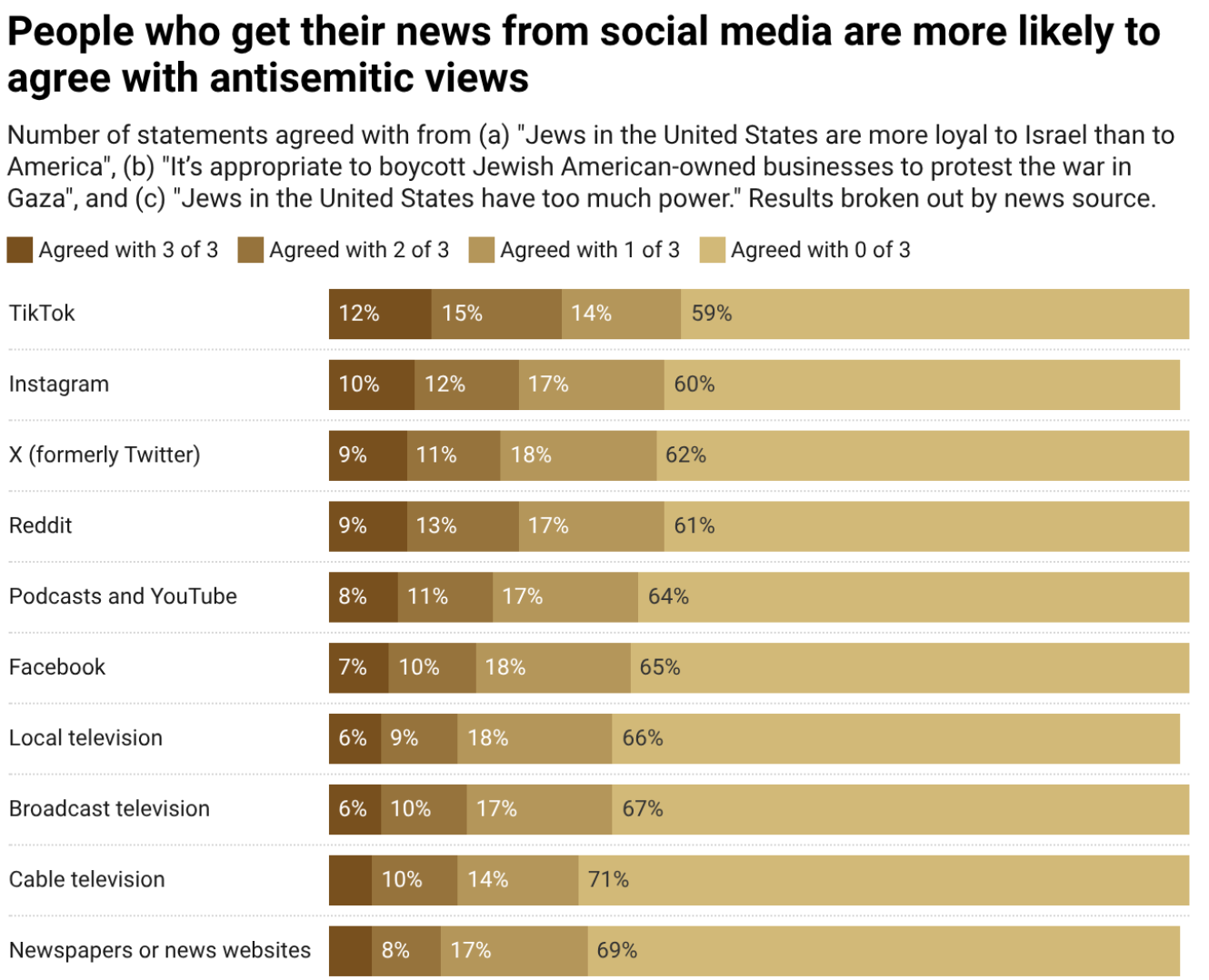
[ALARMING] New Yale Youth Poll finds younger voters hold decidedly more antisemitic beliefs: Antisemitic views were highest among those who rely on social media for their news by Haley Cohen for the JewishInsider
The Yale Youth Poll, an undergraduate-led research group based at Yale University, polled over 3,400 American voters, more than half of whom were under 35, between March 9-23.
From the Survey: Building on the work of our fall 2025 poll, we tested three statements commonly considered to be antisemitic
Jews in the United States are more loyal to Israel than to America.
It’s appropriate to boycott Jewish American-owned businesses to protest the war in Gaza.
Jews in the United States have too much power.
…most voters (67%) agreed with zero of the three statements, though some agreed with one (17%), two (9%), or even all three (6%).
Younger voters were again more likely to agree with these statements: 10% of voters ages 18-34 agreed with all three statements, compared to just 2% of voters ages 65 and above.
Among all voters, 35% agreed with the statement “America should end the slavish surrender to Israel, its wars, and its demands for foreign aid,” which is paraphrased from comments Fuentes made in a video. But among the youngest respondents, agreement rose to 55% of voters ages 18-22 and to 52% among those 23-29 years old.
…34% of voters agree with Tlaib’s characterization of Israel as an “apartheid state” engaged in “racist oppression” of Palestinians. This agreement spikes sharply among younger voters, rising to 55% for those 18-22 and 54% for those 23-29.
Most respondents said they disagreed with several antisemitic conspiracies and statements of Holocaust distortion. However, 25% of voters agreed that “Jews have an extremely organized international community that puts their own interests before those of their home countries.”
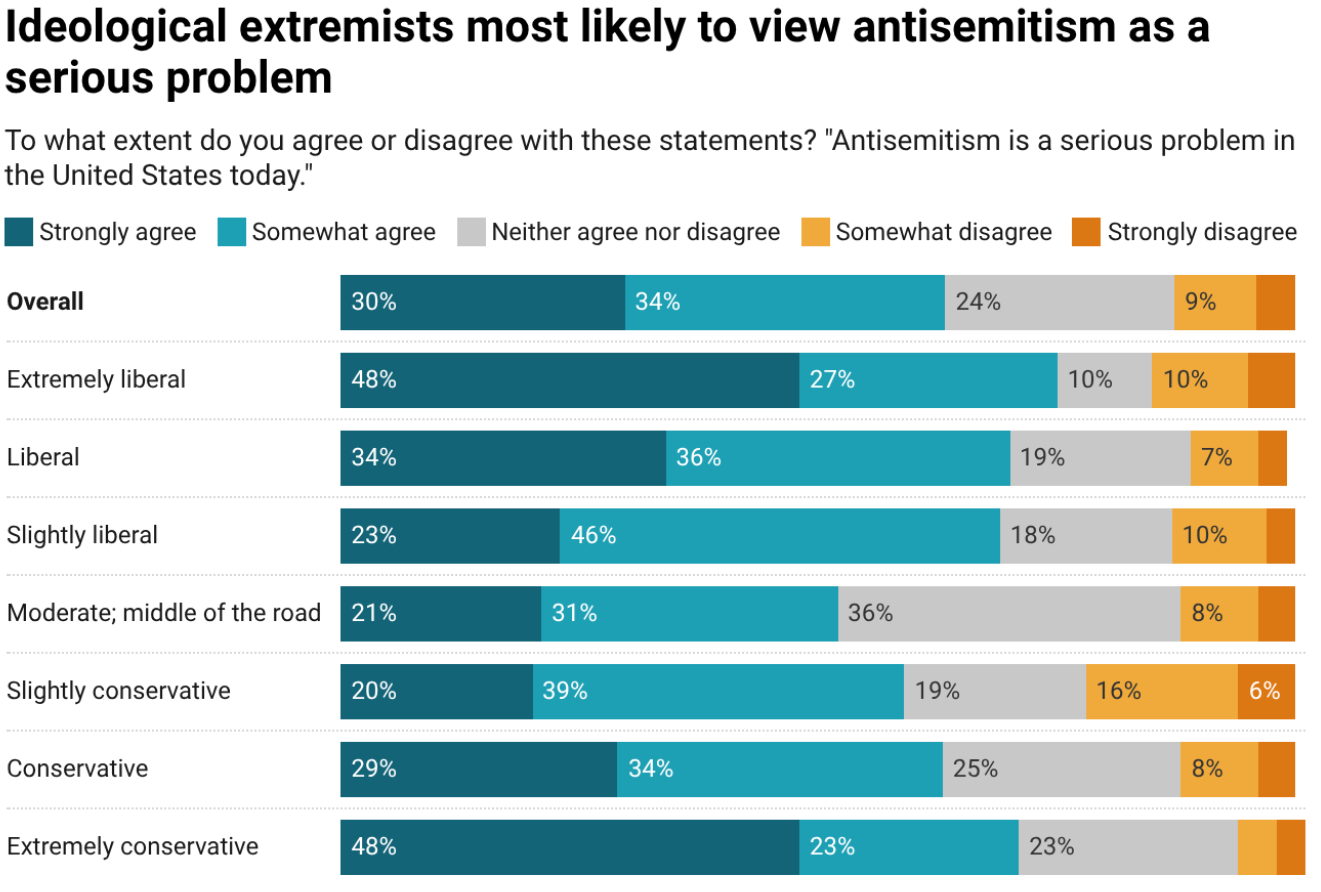
Furthermore, roughly 3 in 10 voters said they support Christian nationalism (27%), believing the U.S. should be declared a Christian nation, and 31% said that being Christian is key to being “truly American.”
Two-thirds of voters rejected all three antisemitic statements presented to them in the survey, which were “Jews in the United States are more loyal to Israel than to America”; “It’s appropriate to boycott Jewish American-owned businesses to protest the war in Gaza”; and “Jews in the United States have too much power.”
Link: New Yale Youth Poll finds younger voters hold decidedly more antisemitic beliefs
Link to Full Survey: Spring 2026 Results | Yale Youth Poll
Casualties: 13 Americans; 37 Israelis (+2)
Israel
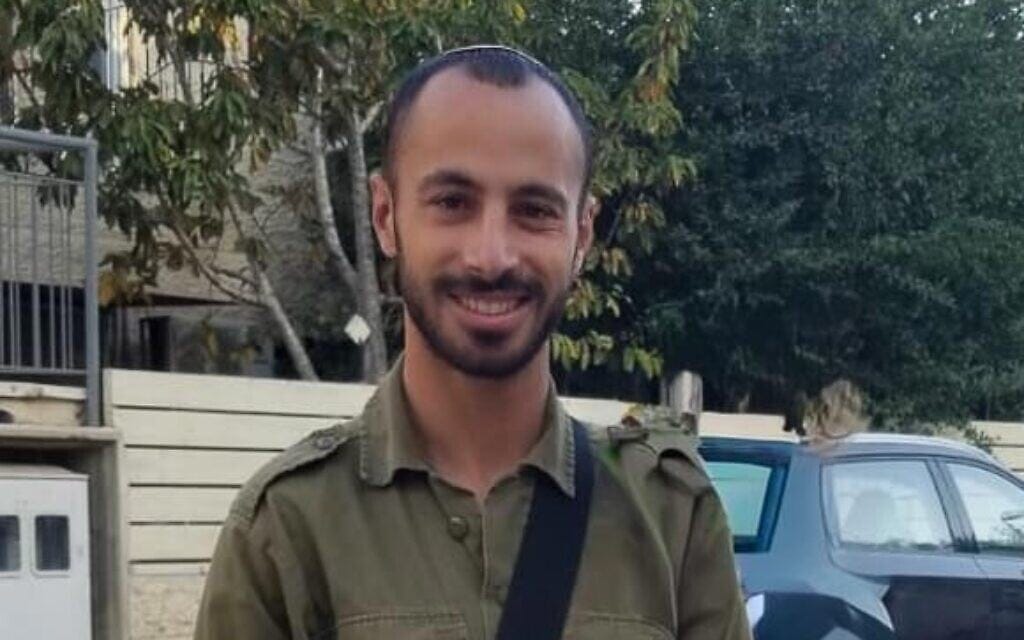
Sgt. First Class (res.) Lidor Porat, 31, of the 769th “Hiram” Regional Brigade’s 7106th Battalion, from Ashdod, was killed and nine others were wounded, including one seriously, after being hit by an explosive device in southern Lebanon yesterday.
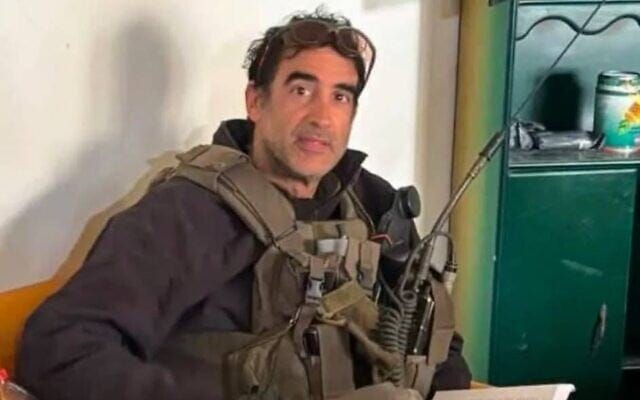
Warrant Officer (res.) Barak Kalfon, 48, of the 226th Reserve Paratroopers Brigade’s 7056th Battalion, from Adi in northern Israel, was killed and three other soldiers were wounded on Friday after an explosive device detonated by them in southern Lebanon. He worked as an engineer at Rafael, the state-owned defense firm, and is survived by his wife and two daughters.
United States
No additional causalities to report.