Israel Update
NO MORE HOSTAGES; IDF Soldiers lost since October 7th: 925
Antisemitism
[REPORT] Blue Square Alliance publishes: Coded, Conspiratorial, and Accelerated: The State of Antisemitism Online - 2025 Year in Review
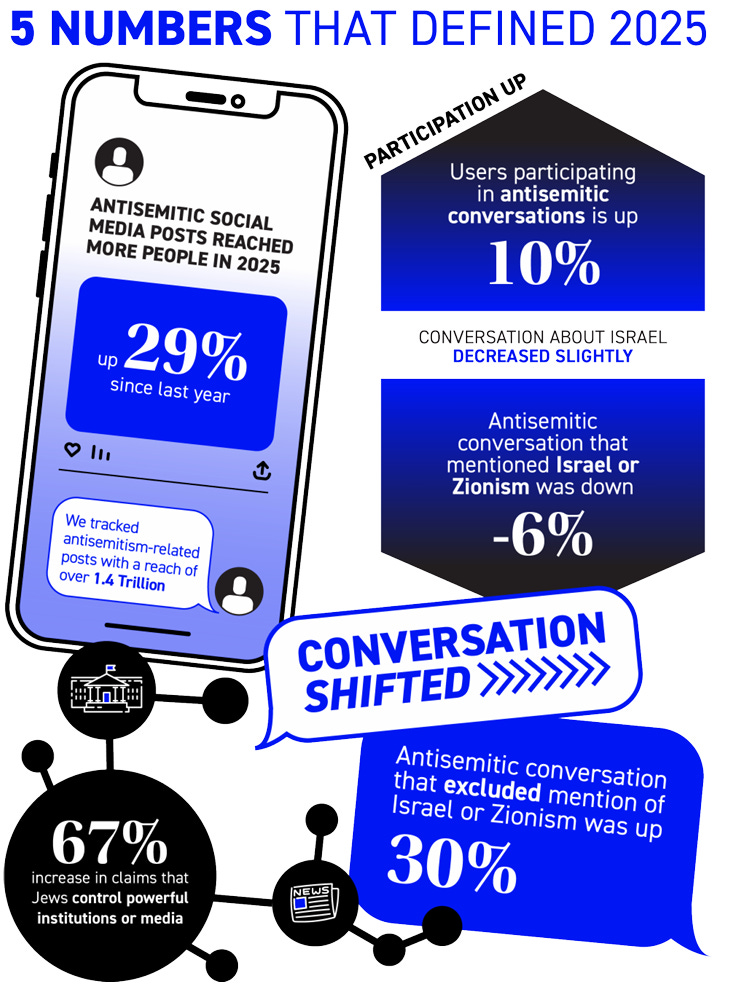
Total volume slightly down; participation up: Mention volume dropped by 6% year-over-year, while the number of users participating in these conversations increased by 10%.
Why it matters: Even with fewer total posts, more people engaged—suggesting diffusion into broader audiences and a shift away from a small set of high-volume moments or accounts.
Israel/Zionism-driven volume declined, but when excluded, conversation rose and stayed elevated: Israel and war discussions decreased, contributing to the overall decline, but conversation about Jews and antisemitic themes without Israel/Zionism terms increased.
Why it matters: The apparent “cooling” is misleading: antisemitism didn’t fade—it shifted away from Israel centered discussions and became more embedded in cultural and political discourse, with greater focus on Jews.
Holocaust/Nazi references became a primary rhetorical weapon: Holocaust-related discourse was driven less by historical discussion and more by political weaponization; internally, we estimate ~50% involved contemporary political comparisons.
Why it matters: Normalizing Nazi and Holocaust analogies trivializes the Holocaust and can erode public understanding of—and sensitivity to—the atrocities committed by the Nazis.
Conspiracy narratives normalized further—especially “power/control” claims about Jews and U.S. politics: “Jewish control” narratives and conspiracies blaming Jews for cultural subversion were more common on social media, while more extreme conspiracies blaming Jews for causing harm in the world grew at faster rates.
Why it matters: Conspiracies act as an engine: they turn uncertainty into blame and help antisemitic ideas travel across communities through insinuation rather than overt slurs.
AI became a major part of the story this year: Acting as a content generator, amplifier, and “fact-checker,” AI shaped the conversation as a cited authority, a source of synthetic/remixed content, and a trigger for viral spikes tied to platform incidents.
Why it matters: AI compresses the distortion cycle—making it easier to manufacture artifacts, accelerate reach, and rapidly fuse misinformation with conspiratorial antisemitic frames. As technology continues to evolve, it will continue to blur the lines between real and fake information on social media.
Closing Implication:
The story of 2025 is that antisemitism online did not recede—it repositioned. It became less dependent on a single geopolitical frame and more embedded in the broader attention economy: conspiratorial, coded, and increasingly shaped by platform and AI dynamics.
That shift raises the stakes for 2026: the question is not only how much conversation exists, but how quickly it mutates, how widely it spreads, and what kind of behavior and fear it produces in the real world.
Link to Full Report: Coded, Conspiratorial, and Accelerated
Lessons from Clausewitz about the Information War against Israel by John Spencer and Michal Cotler-Wunsh with Tikvah Ideas
During the war that was launched against Israel on October 7, 2023, it became commonplace for those following events closely to speak of an “eighth front.”
The weapons used weren’t rifles and rockets, but images, social media, and press releases. Here Israel’s enemies fought not to kill and maim, but to demoralize and to break spirits.
While this kind of warfare is accelerated in a digital age where propaganda can travel across the world in a matter of seconds, there is nothing new about it. It would have been familiar to the great Prussian military theorist Carl von Clausewitz, who, 200 years ago, understood that this front can be decisive.
After repeated conventional wars failed to destroy Israel, its enemies adapted. Clausewitz wrote that the aim of war is to compel the enemy to do one’s will. When military compulsion failed, countries like Egypt and Jordan decided to seek peace with Israel. But others, like Syria, the Palestine Liberation Organization, and later Iran, shifted to legal, moral, and political compulsion, using propaganda and perverse moral reasoning to convince the world that Israel is always the aggressor, and any attempt it makes at self-defense is illegitimate.
Clausewitz famously taught that war is the pursuit of politics by other means. Today, Israel’s enemies use politics to pursue war by other means.
Anti-Semitism is not mere prejudice, but a way of seeing malign Jewish influence behind all the world’s ills. This ancient, ever-mutating hatred latches on to the guiding social constructs of each era—religion, with deep roots in both Christian and Muslim culture; science, with the Nazis depicting Jews as an inferior race that must be destroyed; modern politics, in the Protocols of Elders of Zion and Soviet propaganda; and the “secular religion” of human rights in a post-World War II international rules-based order—conditioning people to believe and to peddle blood libels about “the Jew” as all that is evil, employing lies that are often both vicious and absurd.
But the most effective tool may have been silence about Hamas’s depredations: speaking constantly about imaginary Israeli war crimes in order to drown out any mention of actual Palestinian ones…Through a kind of moral alchemy, evil was proclaimed good and good evil.
Anti-Semitism, with its ability to mutate, has hijacked, redefined, and inverted international law and organizations ostensibly dedicated to human rights—turning them into unconventional weapons on this eighth front.
Those entrusted to uphold and protect international law have time and again been willing to twist or ignore it in order to condemn Israel—including in the UN Human Rights Council, the International Criminal Court, and the International Court of Justice.
All the more so, commentators, journalists, and politicians with minimal knowledge of either the law or the nature of modern warfare make absurd proclamations about the IDF’s conduct that are all too readily believed.
In the short term, this information warfare aims to turn popular opinion in the West against the Jewish state, influencing governments to isolate Israel and pressure it to show restraint. A sufficient quantity of such pressure can stop the fighting and leave Hamas, Hizballah, and their allies intact. But there is also a strategic, longer-term goal: to fracture Western societies from within and undermine their moral confidence.
For years, enormous sums have been invested in the UN and its agencies, universities, K-12 education, media outlets, cultural institutions, and sports diplomacy to shape narratives and normalize extremist worldviews, with anti-Semitism as both symptom and weapon. This is how modern ideological warfare is waged: slowly, legally, and largely unnoticed until its effects are irreversible.
Too much of the international conversation continues to frame the conflict narrowly as Israel versus Hamas…The war is waged by a broader totalitarian axis intent on destroying the very ideas of freedom, democracy, and coexistence, of which Israel (and the Jews) have become a symbol.
…Rabbi Jonathan Sacks warned, anti-Semitism is almost always coupled with civilizational rot. If the distortions of the laws of war employed against Israel become accepted interpretations, ruthless terrorists will have a permanent advantage over law-abiding Western militaries. Future enemies will copy the strategies of Hamas, knowing that they can justify mass rape and deliberate murder, turn civilian populations into human shields, and then win global sympathy.
Too often, the distorting lens of anti-Semitism has prevented those who cherish life and liberty from learning the hard lessons Israel has paid for in blood, lessons about conventional warfare, civil resilience, emergency medicine, education, and the defense of democratic societies under sustained attack.
Israel’s experience shows us the war we are already fighting. Any Western democracy that fails to recognize this reality risks defeat in the next war, possibly before the first rounds are fired.
Link: Lessons from Clausewitz about the Information War against Israel
Israel/Middle East Related Articles and Analysis
The Only Way to Disarm Hamas by Elliott Abrams, Eric Edelman, and Rena Gabber in Foreign Affairs
…to move from a cease-fire to a sustainable peace, negotiators will need to disarm and dethrone Hamas. And so far, the group has largely refused to give up its weapons. In fact, Hamas is reasserting its authority across much of the Gaza Strip by killing off its competitors and repeatedly firing on the Israel Defense Forces.
There is no easy way to keep Hamas down. The IDF wants more time to rest, refit, and re-equip, and Israel would likely suffer from additional political and diplomatic repercussions if it launched a renewed ground offensive in Gaza.
The Palestinian Authority’s forces are not strong enough to fight Hamas, nor are they interested. And the states willing to join Trump’s proposed international stabilization force for Gaza do not want their troops fighting against the group.
But there is a fourth option: private military contractors. Operating under the right rules of engagement and in accordance with Western best practices, private contractors have a track record of successfully operating in difficult environments.
In Gaza, such forces, if properly supervised, could effectively and responsibly clear areas of Hamas militants and infrastructure. Contractors, in other words, could successfully limit Hamas’s power over Gaza and its populace.
Hamas was battered by Israel’s military operations, but it was by no means destroyed. It still controls much of its extensive prewar tunnel network and a multitude of booby-trapped buildings.
On the first day of the cease-fire, Hamas mobilized around 7,000 fighters in order to reassert its authority over the enclave. It is both rebuilding and reasserting itself across the half of Gaza that isn’t occupied by Israel, which is where almost all of the strip’s two million residents live.
In theory, United Nations forces could move into the western half of Gaza instead of the IDF…. But given the political constraints under which UN forces have traditionally operated, such peacekeepers would likely prove ineffective—much as they have in Lebanon, where they failed to stymie the rearmament of Hezbollah and halt its military deployments south of the Litani River…UN peacekeepers are just that—peacekeepers. They are not equipped to handle a situation in which Hamas becomes powerful enough that intensive military action is needed.
The Trump administration is aware of these issues; that is why it proposed an international stabilization force…But these states have been clear that they will not join the ISF if it means fighting Hamas.
The ISF will not materialize in the way it has been envisioned, which is as a multilateral force that would serve as Gaza’s “long-term internal security solution.” And even if it does come together in this manner, it will probably be ineffective. The ISF’s rules of engagement, for example, might not permit it to disarm Hamas.
Top-level security contractors are a viable but overlooked option for ridding postwar Gaza of Hamas. They are staffed by well-trained, highly capable military personnel with experience serving in elite units. They will not shy away from potential conflict with Hamas terrorists.
A demilitarizing force composed of private contractors could also come together quickly…That would allow it to push Hamas back before the group gains even more power.
Contractors also have a strong track record. Many have long reliably, responsibly, and effectively supported American military operations…The degree of difficulty in Gaza is undoubtedly higher, but with sufficient numbers and strong backing by Israel, the United States, and Arab countries, contractors stand at least as good a chance of success as an international stabilization force willing to take on Hamas.
As private contractors disarm Hamas, the Board of Peace can create an ISF to keep the peace. This force would be charged with ensuring that Hamas fighters do not regain control of hospitals and other infrastructure. It would also protect border routes and secure food delivery. A new Palestinian police force, meanwhile, would support the ISF and help it maintain the rule of law.
Demilitarizing Hamas will be an uphill battle no matter who is doing the fighting. It may ultimately require the IDF to reenter the parts of Gaza from which it has withdrawn. Hamas has many weapons and resources, and it will use them all in a desperate effort to maintain power.
Disarming Hamas is essential to reaching a durable peace, and private contractors are an essential part of any viable path forward. They must be deployed, and as quickly as possible.
Europe’s Hamas Problem: Financing Networks, External Terrorist Plots, and the Italian Model by Benjamin Ames with The Jerusalem Institute for Strategy and Security (JISS)
Italian authorities recently dealt a substantial blow to Hamas’ financial network in the country. In late December 2025, Italian police arrested seven individuals and issued international arrest orders for two others suspected of funneling millions to Hamas and its affiliated associations. One of the arrested individuals was Mohammad Hannoun, a U.S.-sanctioned Ramallah native, who has operated in Italy and has been on the radar of authorities since the early 1990s.
Security experts and law enforcement have long been aware of the risk posed by Hamas’ exploitation of European financial and legal environments. Beyond financing, Hamas has largely refrained from conducting terrorist attacks in Europe prior to October 7, 2023.
However, since October 7, 2023, Hamas appears to have moved beyond its prior strategic narrative, as European authorities have disrupted multiple alleged terrorist plots across the continent. As the threat of Hamas terrorist attacks in Europe has increased, the need for formal security and intelligence cooperation between Israel and the EU has become more pressing than ever.
Under the guise of raising funds for Palestinian civilians, Hannoun operates several organizations in Italy…These entities serve as front organizations that divert funds to Hamas’ military wing.
In 2024, the European Leadership Network (ELNET) published a series of reports revealing an extensive Hamas-affiliated network operating in various countries including the United Kingdom, Germany, Italy, France, Belgium, and the Netherlands…This ecosystem also encompasses a network of NGOs and advocacy organizations, including the European Palestinians Conference (EPC), which has functioned as a recurring convening platform for Hamas-affiliated actors across multiple European countries.
The repeated convergence of senior Hamas-affiliated figures from different organizations at shared European forums illustrates how these entities interact through common platforms, reinforcing a broader, pan-European fundraising ecosystem. Individuals within this network, such as Hannoun, have spent decades embedding themselves within European civil society structures to advance Hamas’ foreign interests.
Some European countries in addition to Italy have taken decisive action in response to the threat…That said, many European nations have been slow to catch up in confronting Hamas’ financing infrastructure in a substantive manner.
Over the past two years, European authorities have thwarted numerous terrorist plots and uncovered weapons caches linked to Hamas, largely with the help of Israeli intelligence…Operatives involved in these terrorist plots have reportedly traveled abroad to meet with, or receive instructions from Hamas members in Turkey, Lebanon, and Qatar.
Israel and Europe have a history of intelligence cooperation that has largely remained informal and limited in scope, often due to political and institutional constraints.
The Italian investigation demonstrates how a nationally initiated case, supported by intelligence sharing and cross-border coordination, can shed light on Hamas’ intertwined financing and external operational activity in Europe. Rather than treating such activity as isolated national phenomena, the Italian case shows the value of following financial and organizational linkages across borders.
With reports of foiled Hamas operations in Germany, the Netherlands, Denmark, Bulgaria, and Poland since October 7, 2023, Europe can no longer afford to address the threat in a piecemeal manner.
Ideally, this framework would allow both Israeli and European authorities to integrate capabilities and personnel to proactively identify and thwart Hamas’ financial and attack planning networks operating in Europe. Recent security agreements established between Israel and Europol, such as the 2018 working agreement, can potentially serve as building blocks for enhanced cooperation.
Link: Europe’s Hamas Problem: Financing Networks, External Terrorist Plots, and the Italian Model
Iran
[PODCAST] The Iran Breakdown with Mark Dubowitz: In the Eye of the Storm (feat. Rich Goldberg)
The regime in Iran has slaughtered tens of thousands of Iranians and plunged the country into an internet blackout — and dared the world to look away. Still, President Trump warned that American support was coming as U.S. military vessels made their way to the region. And yet — the decisive moment hasn’t arrived.
In this episode of The Iran Breakdown, host Mark Dubowitz is joined again by Rich Goldberg for a timely assessment of the waiting game: what military options are now on the table, why missiles — not nukes — may be the real center of gravity, whether negotiations are strategy or psychological warfare, and how delay reshapes deterrence, escalation, and the fate of the Iranian people. This isn’t a pause — it’s a countdown.
The West’s silence on Iran is the latest warning of Islamists’ growing power: Iranians must endure a double tragedy: the crushing of their dreams by the regime and the shameful hypocrisy of Western progressives by Dr. Qanta Ahmed in The Telegraph
I visited the Shah’s Iran in 1975 as a young girl, and it felt tolerant, elegant and modern.
Along the way, my father took me to see innumerable wonders, including the blue mosque in Isfahan and the gilded, gleaming domes of Qom.
But it was in Qom, the religious epicentre of Shia Islam, that I also saw the men who would go on to banish that tolerant, liberal Iran to the history books. One of the turbaned clerics chastised my mother – despite her hair being covered in a dupatta – for her lack of a chador. It was the first time I saw enforced veiling.
In the remarkably courageous street protests that broke out at the end of 2025, we saw another Iran, unbowed, despite half a century of tyranny.
Islamism is an artificial, man-made 20th century totalitarian ideology that steals the language and metaphors of my religion – Islam – but distorts them for other ends, holding at its core a cosmic enmity towards Judaism, Zionism and Israel. These themes have defined the Iranian regime as a theocratic pseudo-democracy, an Islamist dictatorship masquerading as an Islamic republic.
Under the country’s constitution, the Islamic Revolutionary Guard Corps is mandated to export jihad, and it does so through the aggression of Iran’s proxies and via Islamist terrorism globally.
…once again, the regime resorted to brute force to cow the protestors. Iranians seem to have been targeted by snipers, shot in the face and genitals, murdered and imprisoned by the tens of thousands.
Perhaps Donald Trump will still act…Yet even if he does, the world must still reckon with something else: the silence in the West. Where were the outpourings of protest in solidarity with the Iranians defying their regime? Instead, the US and Europe had empty streets; it was business as usual on our otherwise politically militant university campuses; there were few if any demonstrations, and Iranian consulates and embassies were largely left unmolested by anti-regime protests.
In New York City, the lack of reaction was particularly noteworthy given we have just elected our first Muslim mayor, Zohran Mamdani. As a state assemblyman, and himself a Shia Muslim, Mamdani protested so vigorously for the Palestinians that he was once arrested for blocking traffic. He refused to condemn rankly Islamist calls to “globalise the Intifada”. Yet on Iran, he was silent until he issued a tepid statement almost a month into the brutal protests.
Perhaps protests in the West have been throttled by the stranglehold of Islamophobia – an artificial construct that became mainstream after Ayatollah Khomeini issued his 1989 fatwa against Salman Rushdie. (That edict globalised calls for Rushdie’s execution for blasphemy due to the publication of The Satanic Verses). Since then, criticism of Islam or its institutions has been effectively deterred, even when the critics themselves are practising Muslims.
The fact that the Iranian regime calls itself Islamic is awkward for Western progressives, especially if they are unable (or unwilling) to distinguish between Islam and Islamism
Western progressives are similarly compromised by critical race theory – indoctrination integral to woke ideology. Palestinian victimhood is lionised above all other struggles, partly because their so-called “oppressors” (Israelis) are erroneously deemed to be white. Thus, Islamist anti-Semitism merges seamlessly with virulent far-Left anti-Semitism under the banner of “anti-Zionist anti-racism”.
When Islamists murder Muslims in Iran, Iranians are not accorded such “prestige” victimhood.
There is also the small matter of money. There is a growing body of evidence that many pro-Palestinian protests were not spontaneous outpourings of support for the cause, but systematically organised and richly financed.
With Iran, the money in the West appears to be on the regime’s side. Extraordinary investigative research by journalist Asra Nomani for the Pearl Project has identified a network of allegedly pro-Iranian groups, encompassing “socialist revolutionaries, Islamist activists, foreign-influenced nonprofits and even political operatives from Democratic groups”, what she has dubbed the “woke army”.
We should all hope that the Iranian regime can be brought to its knees. But even then, we will still be left with the hypocrisy and corruption of our own societies.
Link: The West’s silence on Iran is the latest warning of Islamists’ growing power
Should Iran’s Executioners Go Unpunished? By Bret Stephens in the NYT
So far, a U.S.-based Iranian human rights group says it has verified the killing of more than 5,500 protesters and is still reviewing 17,000 additional cases. Many thousands more were injured, and independent reports indicate that tens of thousands of Iranians have been arrested or arbitrarily detained.
An Iranian doctor in the city of Isfahan told The Times that they had seen “young people whose brains were smashed with live bullets, and a mom who was shot in the neck, her two small children were crying in the car, a child whose bladder, hip and rectum was crushed with a bullet.”
That’s the question that, at this writing, confronts the Trump administration. Not the United Nations Security Council, where Iran can rely on diplomatic cover from its close friends in Moscow and Beijing. Not the European Union, which has condemned and sanctioned Iran, but lacks any additional means to punish it. Not Arab leaders, who would prefer a weakened Iran that brutalizes its own people to a broken Iran that exports instability — or a liberated Iran that inspires emulation.
And not the campus activists and global do-gooders who care so deeply about Palestinian lives but not about Iranian ones.
So it’s left to the United States to impose meaningful consequences on the Iranian regime for one of the worst atrocities of this century.
Iran could always become more pliant, if only to play for time. But the odds are growing that the president will order some sort of attack once sufficient U.S. forces are in the region, which could happen as early as this week.
Is the military option wise? The argument against it is that it’s unlikely to achieve much.
Weighed against all this is a different set of risks: of the example of a U.S. president who urged protesters to go in the streets and said help was on the way only to betray them through inaction…
And something else: Do we really want to live in a world in which people like Mohseni-Ejei, the judicial leader, can terrorize people with utter impunity? Have decades of vowing “Never again” — this Tuesday marks the anniversary of the liberation of Auschwitz — taught us nothing more than to offer pro forma condemnations when thousands of protesters are gunned down by modern-day Einsatzgruppen?
How the Son of Iran’s Supreme Leader Built a Global Property Empire by Ben Bartenstein in Bloomberg
On a tree-lined street in north London, known as “Billionaire’s Row,” a clutch of mostly empty mansions sit behind tall hedges and blacked-out gates. As school children wander by, private guards in dark SUVs patrol outside.
The ultimate ownership traces back, through layers of shell companies, to one of the most powerful men in the Middle East: Mojtaba Khamenei, the second-eldest son of Iran’s Supreme Leader.
The 56-year-old cleric, touted as a potential successor to his father, Ayatollah Ali Khamenei, oversees a sprawling investment empire…His financial power has embraced everything from Persian Gulf shipping to Swiss bank accounts and British luxury property worth in excess of £100 million ($138 million), say the people, who requested anonymity for fear of retribution or because they’re not authorized to speak publicly.
Funds for the transactions have been routed through accounts at banks in the UK, Switzerland, Liechtenstein and the United Arab Emirates, according to documents seen by Bloomberg and people familiar with the matter. The funds originate primarily from Iranian oil sales, the people said.
None of the documents seen by Bloomberg list assets directly in Khamenei's name. Instead, many of the purchases appear in the name of an Iranian businessman, Ali Ansari, sanctioned by the UK in October.
Iran’s state media depicts the Supreme Leader and his family — part of a revolutionary movement that toppled a monarch in 1979 in the name of the poor and Islam — as living an austere and pious life. There’s little indication the family has used the foreign assets to fund lavish lifestyles. Still, the hidden fortune of the younger Khamenei conflicts with that image of piety promoted by the regime, especially in the wake of rising poverty and widespread unrest and protests against the Islamic Republic that have helped rally support for the ousted monarchy and seen thousands killed in Iran since the start of the year.
The story of the Khamenei overseas investment portfolio illustrates how Iran’s elite managed to move capital abroad despite the country being subject to one of history's toughest sanctions regimes for the last two decades over its nuclear program and support for armed groups that oppose Israel and Western policy in the Middle East.
Ali Ansari, a 57-year old construction magnate, was last year described by British authorities as a “corrupt Iranian banker and businessman” as he was sanctioned for “financially supporting” the activities of Iran’s IRGC — a powerful branch of the military — which reports directly to the Supreme Leader and is itself sanctioned by the UK. Ansari is not subject to any sanctions in the EU or the US.
As Ansari’s domestic empire expanded, so too did his role as Mojtaba Khamenei’s financial conduit abroad establishing banking relationships across Europe and routing profits from oil exports through a labyrinth of companies in the UAE, according to some of the people.
Much of the money in the network has flowed through non-Iranian firms like Ziba Leisure Ltd., registered in Saint Kitts and Nevis, the Isle of Man-based Birch Ventures Ltd. and A&A Leisure Ltd. as well as Emirati entities such as Midas Oil Industries FZC and Midas Oil Trading DMCC.
Officially the state-owned National Iranian Oil Company sells the country's crude, but sanctions have pushed much of the trade into opaque channels involving front companies, middlemen and informal traders, according to US officials and people familiar with the business.
Iran’s Supreme Leader heads one of the country’s wealthiest organizations which was created through the seizure of thousands of properties and assets after the revolution. Called the Execution of Imam Khomeini’s Order, also known as SETAD, it manages billions of dollars worth of assets, commercial holdings and charities. It’s one of the largest state-owned conglomerates in the Middle East, operating in sectors ranging from insurance to energy and telecoms.
A European official involved in money-laundering investigations says that the UK asset freeze on Ansari might prompt a fire sale of the network’s European assets in case restrictions are imposed by the EU.
Link: How Iran Supreme Leader Khamenei's Son Built a Global Property Empire
Casualties (no change)
1,994 Israelis have been killed including 925 IDF soldiers and police since October 7th
The South: 476 IDF soldiers during the ground operation in Gaza have been killed. The toll includes three police officers (two of which were killed in a hostage rescue mission) and two Defense Ministry civilian contractors.
Iran: 34 Israelis have been killed in Israel from missiles attacks from Iran
The North: 133 Israelis (85 IDF soldiers) have been killed during the war in Northern Israel
The West Bank: 87 Israelis (32 IDF and Israeli security forces)
Additional Information (according to the IDF):
6,419 IDF soldiers have been injured since the beginning of the war, including at least 955 who have been severely injured.
2,995 IDF soldiers have been injured during ground combat in Gaza, including at least 565 who have been severely injured.
The Gaza Casualty Count: According to unverified figures from the Hamas-controlled Gaza Health Ministry, 71,769 total deaths have been reported, with a civilian/combatant ratio: 1:45 (which is remarkably low by the standards of modern urban warfare).